
FT8 Isn’t Killing Ham Radio — But It Is Changing It
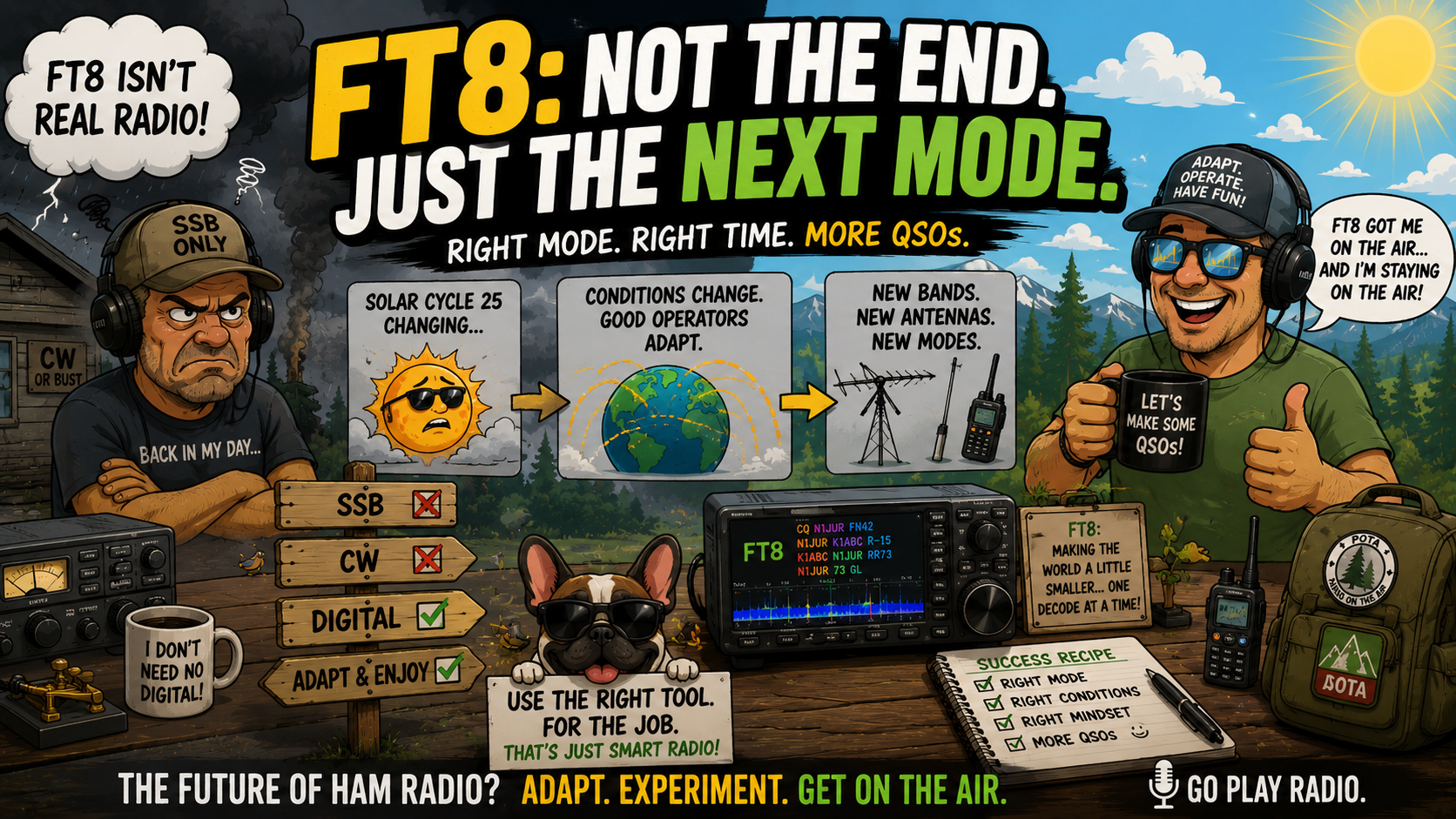
I’m going to try something dangerous.
I’m going to write about FT8 without arguing about FT8.
No.
Seriously.
We’re not going to decide if it’s “real radio.”
We’re not going to count how many buttons you have to push.
And we’re definitely not going to compare an FT8 contact to ordering something from a vending machine.
We’ve done that conversation.
A lot.
Instead, I think there’s a much more interesting question.
How is FT8 changing the way we operate?
Because whether you love the mode, hate the mode, or only use it when you need ten contacts at a park before getting back to work…
FT8 has changed amateur radio.
And I think the next few years are going to make that even more obvious.
Let’s Start With What FT8 Actually Does Well
FT8 is a weak-signal digital mode.
That description isn’t very exciting.
But what the mode can accomplish is.
FT8 allows stations to exchange the basic information needed for a contact under conditions where a traditional voice contact might be difficult or impossible.
Callsign.
Signal report.
Confirmation.
Done.
The exchange is structured.
The timing is structured.
The software does a lot of the heavy lifting.
And that is exactly why the mode works.
FT8 wasn’t designed to replace a 45-minute conversation about your radio, the weather, and the medical procedure you had three years ago.
Different job.
Different tool.
If I want a conversation, I’ll use phone.
If I want to send a message, I might use a different digital mode.
If I want to see what my station can hear and make weak-signal contacts?
FT8 is an incredibly useful tool.
Maybe the problem is that we’ve spent too much time comparing modes that were never trying to accomplish the same thing.
FT8 Changed How We Look at a Dead Band
Remember spinning across a band and hearing nothing?
The natural conclusion was pretty simple.
Band’s dead.
Move on.
FT8 changed that.
Now an operator can open WSJT-X, look at the waterfall, and see signals buried far below what they might hear through the speaker.
Suddenly the band isn’t dead.
It’s just quiet.
That’s a pretty significant difference.
FT8 has given operators another way to look at propagation.
I can transmit and quickly see where my signal is being received.
I can watch stations appear from different parts of the country.
I can see a band begin to open.
For many operators, FT8 has almost become a propagation tool.
Turn on the radio.
Check FT8.
See what’s happening.
Then decide where to operate.
That’s a very different way of reading the bands than simply spinning the VFO.
Want More Portable Radio Content?
Practical portable operating, POTA discussions, gear reviews, Brew & Activate livestreams, and real-world ham radio content.
Solar Cycle 25 Spoiled Us a Little
Let’s be fair.
We’ve had some pretty good radio conditions.
Solar Cycle 25 exceeded a lot of early expectations.
Higher solar activity improved conditions on the upper HF bands and gave operators some incredible opportunities.
Ten meters came alive.
Twelve meters got interesting.
Stations running relatively simple antennas were making contacts across the world.
There were days when it felt like you could connect a coat hanger to the back of the radio and work Europe.
Okay.
Maybe not quite.
But you get the point.
Good propagation makes radio feel easy.
And when the bands are open, phone operators are busy.
CW operators are busy.
Digital operators are busy.
Everyone gets to play.
But solar cycles don’t stay at the top forever.
Conditions change.
Bands change.
And operators adapt.
That’s where I think FT8 becomes even more interesting.
What Happens When the Bands Get Harder?
As we move away from the strongest conditions of Solar Cycle 25, we’re going to have days when the bands don’t sound quite as exciting.
Ten meters won’t always be packed.
DX won’t always be 59.
Portable operators running 20 watts and a wire antenna may have to work a little harder.
That’s radio.
But I don’t think operators are going to simply turn their radios off.
They’re going to change modes.
And FT8 is really good at working when conditions become difficult.
Weak signals.
Low power.
Compromised antennas.
Short openings.
That’s the environment where digital weak-signal modes become incredibly useful.
I think we’re going to see more operators using FT8 as part of their normal operating routine.
Not because phone is dead.
Not because CW disappeared.
Because the bands are going to remind us that different conditions require different tools.
Keep the Conversation Going
What’s one thing you stopped bringing to activations because you realized you never actually needed it? Drop into the Discord and tell the Brew Crew.
Join the N1JUR DiscordThe Future Might Be Multi-Mode Operators
This is where I think amateur radio is heading.
For years, operators have identified themselves by mode.
“I’m a phone guy.”
“I’m a CW operator.”
“I only work digital.”
I think portable operating is already starting to change that mindset.
Look at the stations we’re building.
A radio.
A laptop or tablet.
A logging program.
A digital interface.
One station can work SSB.
FT8.
JS8Call.
RTTY.
CW.
Maybe several other modes depending on how deep you’ve gone into the software rabbit hole.
The equipment is already capable.
The operator just has to decide what tool makes sense.
I think the future operator might be less loyal to a mode.
They’ll be more interested in making the contact.
Band conditions are good?
Call CQ on phone.
Signals are weak?
Move to FT8.
Want an actual keyboard conversation?
Use a conversational digital mode.
Need to send structured information?
Use the mode designed for that job.
That’s not one mode replacing another.
That’s an operator understanding the station.
Portable Radio Is Going to Push This Even Faster
Portable operators live with limitations.
Battery.
Antenna.
Power.
Time.
Sometimes all four.
At home, I can sit in the shack and wait for conditions to improve.
At a park during a lunchtime activation?
I’ve got a clock running.
If I’m running 20 watts into a portable antenna and nobody answers my phone CQ, I have a choice.
Keep calling.
Change bands.
Change the antenna.
Or change modes.
FT8 gives portable operators another option.
I’ve had activations where digital modes made the difference.
Not because I wanted to avoid talking to people.
The conditions simply weren’t cooperating.
That’s what I mean when I say FT8 is changing ham radio.
Operators are starting to think about modes as tools.
The Waterfall Is Becoming Part of the Radio
There’s another change happening that I don’t think we talk about enough.
We’re becoming visual operators.
Older radios gave you a frequency display.
You listened.
You tuned.
You listened again.
Modern radios give us waterfalls.
Spectrum scopes.
Decoders.
Signal reports.
Propagation maps.
PSK Reporter.
Reverse Beacon Network.
We don’t just hear radio anymore.
We see it.
FT8 fits perfectly into that world.
You can watch stations decode.
You can see your signal being received.
You can compare propagation almost in real time.
For a new operator who grew up looking at screens and data, this makes sense.
The information is visible.
The result is measurable.
That doesn’t make traditional operating obsolete.
But it does change how someone learns the hobby.
We’re Going to Have to Teach Radio Differently
This might be the biggest change.
A new ham today might make their first HF contact on FT8.
Think about that.
Their first experience with HF might not be calling CQ into a microphone.
They may connect a radio to a computer.
Synchronize the clock.
Watch signals decode.
Click a callsign.
And suddenly their signal travels 3,000 miles.
That’s the moment.
That’s when the questions start.
Why did that signal make it there?
Why is 20 meters open?
Why did my signal disappear?
Why can I hear Europe but not the West Coast?
Why did changing my antenna improve my signal report?
Those are radio questions.
FT8 can create curiosity just like a phone contact.
We just have to teach the operator what they’re looking at.
Don’t stop at clicking the callsign.
Open PSK Reporter.
Look at propagation.
Change power levels.
Try another antenna.
Move bands.
Experiment.
That’s where FT8 becomes amateur radio.
Like What’s Happening Here?
N1JUR is built around helping more people get active in ham radio through videos, Field Notes, POTA content, live streams, gear reviews, and community.
If you already watch the channel and want to support more of the work behind it, memberships are one way to help keep the signal going.
Videos. Field Notes. Live Streams. Community.
Membership support helps keep the N1JUR ecosystem moving without turning every page into a pledge drive wearing a callsign hat.
Learn About the Community →FT8 Isn’t the Future of Ham Radio
I don’t think FT8 replaces phone.
I don’t think it replaces CW.
And I don’t think every operator will eventually become a digital operator.
That’s not how amateur radio works.
We collect modes.
We collect antennas.
We collect radios.
Apparently, we also collect coax adapters because I own approximately 4,000 of them and still never have the one I need.
FT8 is another part of the station.
But it is changing our expectations.
We expect to see signals.
We expect propagation data.
We expect software to help us understand what the radio is doing.
And as solar conditions change, I think operators are going to become much more comfortable moving between modes.
The Bands Will Change. So Will We.
Solar Cycle 25 won’t stay at the top forever.
The upper bands will change.
Propagation will change.
Some days will be incredible.
Other days we’ll stare at the radio and question every antenna decision we’ve ever made.
That’s part of the hobby.
But we have more tools than we’ve ever had before.
Phone.
CW.
FT8.
JS8Call.
RTTY.
Weak-signal modes.
Digital messaging.
The interesting part isn’t deciding which mode wins.
The interesting part is learning when to use each one.
FT8 isn’t killing ham radio.
It isn’t saving ham radio either.
It’s changing how operators interact with the bands.
And as propagation changes over the next few years, I think we’re going to see something interesting.
The best operators won’t necessarily be the loudest stations.
They might be the operators who know when it’s time to change modes.
Turn the dial.
Watch the waterfall.
Try something different.
And go play radio.