
Who Gets to Decide What Counts as a POTA Park?
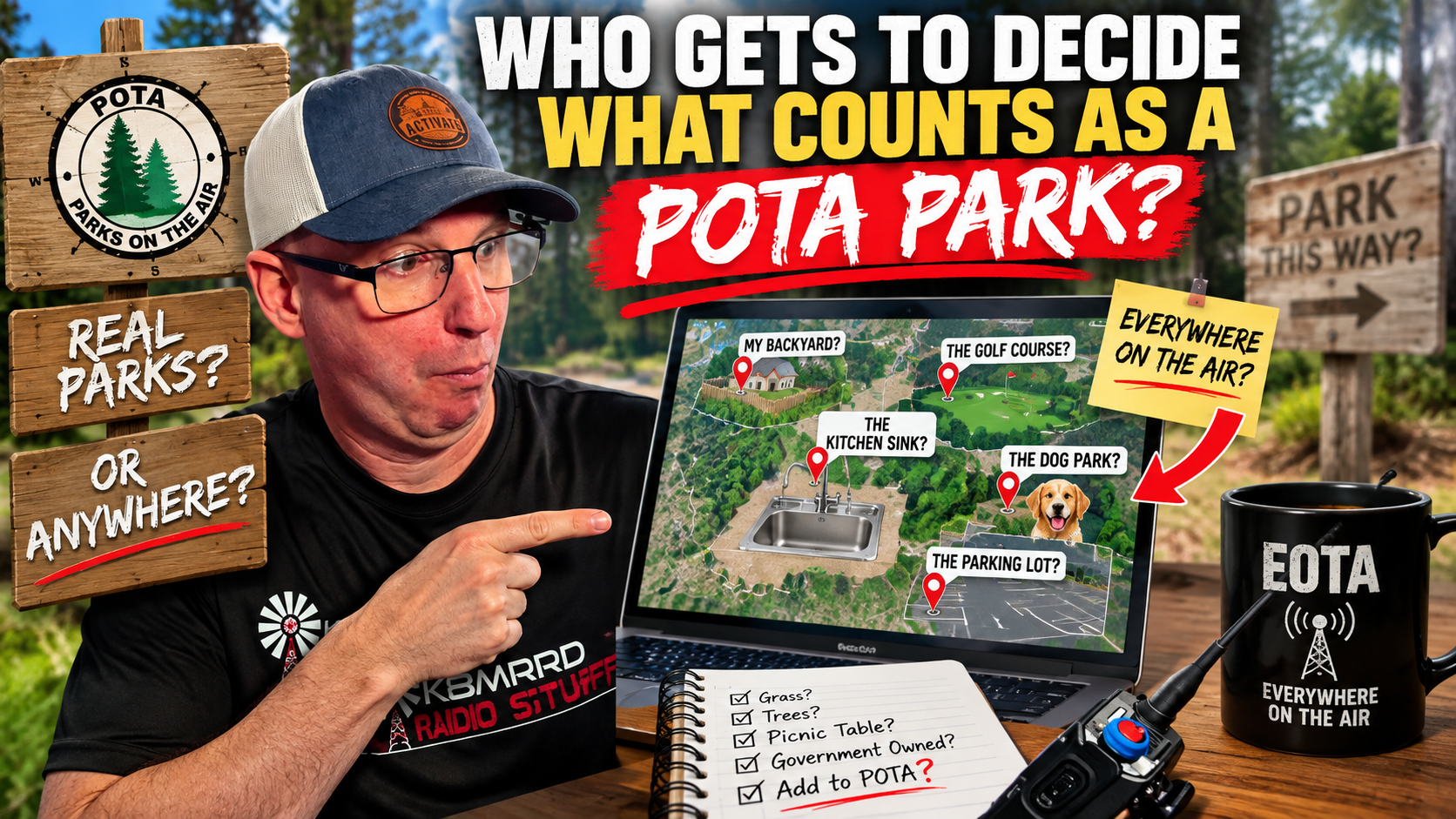
Here's a question that sounds incredibly simple until you actually try to answer it:
What is a park?
Seriously.
You drive past a sign that says "park."
There are trees.
Maybe a picnic table.
Probably a trash can nobody emptied after Labor Day.
Looks like a park.
So obviously it should count for Parks on the Air...right?
Not necessarily.
And that's where things get interesting.
Because once you start looking at how Parks on the Air actually decides what gets a reference number, you realize POTA isn't trying to answer the philosophical question of what humans consider a park.
It's trying to answer a much harder administrative question:
What should a POTA reference represent?
Those are not the same thing.
The Short Answer: Not Every Park Qualifies for POTA
A place doesn't qualify for POTA simply because it has grass, trails, picnic tables or the word PARK on a sign.
POTA has qualification criteria for references.
Under the current rules, new parks generally must be owned and operated by the two highest tiers of government in the country or entity. If a country only has one tier of government, that tier is used. There are provisions for situations where those government systems formally use third parties to manage their parks, but the basic rule is considerably more restrictive than "this looks like somewhere I'd take a radio."
POTA also expects authoritative information about the park. When a formal government website and boundary map exist, those should be associated with the POTA information for the reference.
And there's another important rule:
POTA generally doesn't create a sub-park inside another existing POTA park when both belong to the same government tier or agency.
So no.
We can't simply register every picnic table in America.
I know.
Somebody just had their weekend ruined.
Want More Portable Radio Content?
Practical portable operating, POTA discussions, gear reviews, Brew & Activate livestreams, and real-world ham radio content.
Why Does POTA Need Rules About This Anyway?
This is where I think the conversation gets more interesting than the rules themselves.
Imagine POTA had one qualification rule:
If somebody thinks it's a park, add it.
Sounds wonderfully simple.
For about fifteen minutes.
Then someone submits the neighborhood playground.
Someone else submits the town walking path.
The next person submits the conservation parcel behind their house.
Then a public boat ramp.
Then a cemetery with walking trails.
Then somebody notices that a grassy median technically belongs to the Department of Transportation and contains two trees.
Congratulations.
We've invented Everywhere on the Air.
And yes, I can already see somebody designing the logo.
The problem isn't that those places are bad places to operate.
Some of them might be fantastic.
The problem is that a program built around references needs a consistent answer to:
What does a reference mean?
Without that, the database eventually becomes whatever somebody was able to convince somebody else to add.
POTA Isn't Really Deciding What a Park Is
This distinction matters.
POTA isn't the government.
It doesn't designate state parks.
It doesn't create national forests.
It doesn't decide whether your town's conservation land deserves legal protection.
Instead, POTA maintains a program built around qualifying entities that already exist.
That means the program needs an objective framework for deciding which existing places belong in its reference system.
And objective frameworks sometimes produce results that feel weird.
You might have a beautiful local property with miles of trails, public access and acres of forest that doesn't qualify.
Meanwhile, somewhere else there may be a government-designated property that looks considerably less "park-like" but does.
That's where operators understandably ask:
How does THAT count when THIS doesn't?
Because we're judging with our eyes.
The database is judging with definitions.
The Government-Tier Rule Is the Line
Under POTA's current qualification rules, the major dividing line is governmental ownership and operation.
For the United States, that effectively focuses new references around the appropriate upper governmental levels rather than opening the database to every municipal recreation field or locally managed green space.
You can disagree with where that line is drawn.
That's completely fair.
But some line has to exist.
Because the alternative isn't "more parks."
The alternative is eventually having no meaningful standard for what a reference represents.
And once you understand that, some of the apparently strange POTA decisions start making more sense.
Not necessarily more satisfying.
But more understandable.
Keep the Conversation Going
What’s one thing you stopped bringing to activations because you realized you never actually needed it? Drop into the Discord and tell the Brew Crew.
Join the N1JUR DiscordWhy Can't We Just Add Every Local Park?
I'll admit there is an appealing argument here.
More parks means more places to activate.
More places to activate means more operators getting outside.
More activity means more contacts.
What's wrong with that?
Nothing—until you think about scale.
There are thousands upon thousands of municipal parks, recreation properties, conservation parcels and locally managed public spaces across the United States alone.
Then multiply that problem globally.
Someone has to determine:
whether the place actually exists;
whether it is publicly accessible;
who owns it;
who operates it;
where its boundaries are;
whether it overlaps another reference;
whether its status changes;
and eventually whether it still exists.
That's not just a map problem.
That's a data-management problem.
POTA references need to remain useful years after they're created.
Which brings us to something most activators probably don't think about until it happens to one of their parks.
Parks Can Change
Government properties aren't permanent simply because we gave them a reference number.
Names change.
Agencies reorganize.
Boundaries move.
Properties can be transferred.
Designations change.
And references sometimes need to change with them.
POTA has already gone through large-scale reference changes. In 2024, for example, United States references were moved from the old K- prefix to US-, while the underlying numeric reference generally remained the same. The published change documentation also includes inactive parks because the reference system still has to account for them.
That's a useful reminder:
The number in your log is part of a managed database representing real-world entities.
And the real world refuses to remain conveniently static for ham radio.
Rude, honestly.
What Happens When Your Park Disappears?
This is where an administrative discussion suddenly gets personal.
Imagine you've activated the same reference for five years.
Maybe you've done 73 activations there.
Your first CW activation happened there.
Your first QRP activation.
You took your kid there.
Maybe you finally completed some ridiculous personal challenge sitting at the same picnic table you've used dozens of times.
At some point, the reference stops being just a number.
It becomes your park.
Then its designation changes.
Or its status changes.
Or something about the property means it no longer fits the program.
Suddenly the conversation about database management feels very different.
I understand why operators become attached to references.
POTA isn't only collecting QSOs.
It's collecting places.
And places accumulate memories.
But that still doesn't mean the database should preserve a reference forever simply because we're emotionally attached to it.
The program has to represent what exists now while preserving the historical record of what happened before.
Those two things can coexist.
What About Parks Inside Parks?
Now we get to one of the fun parts.
Multiple references can legitimately overlap.
POTA's activator guidance specifically addresses multiple park references. An activator can operate multiple qualifying parks simultaneously when the station satisfies the activation requirements for each reference.
The official guide gives examples such as a qualifying linear trail passing through another park. If your station is within the trail's activation zone while also within the surrounding park, you may have a legitimate two-fer. It also gives Mount Rushmore and Black Hills National Forest as an example of overlapping references.
That's different from arbitrarily carving one government property into fifteen POTA references.
The references exist because they represent separately qualifying entities.
The overlap is simply where geography gets fun.
And where POTA activators suddenly start staring at maps like they're planning a bank robbery.
Like What’s Happening Here?
N1JUR is built around helping more people get active in ham radio through videos, Field Notes, POTA content, live streams, gear reviews, and community.
If you already watch the channel and want to support more of the work behind it, memberships are one way to help keep the signal going.
Videos. Field Notes. Live Streams. Community.
Membership support helps keep the N1JUR ecosystem moving without turning every page into a pledge drive wearing a callsign hat.
Learn About the Community →So Who Actually Gets a Park Added?
POTA maintains its park list through designated mapping representatives.
If an operator believes a qualifying property is missing or a park needs an edit, POTA directs those requests through the appropriate representative for the state or country rather than letting users simply create references themselves.
That's important.
There is a process.
Finding a place on a map and deciding "this should totally be POTA" isn't the same as determining that it satisfies the program's criteria.
If you find something you believe qualifies, document it.
Find the authoritative government source.
Find the boundary information.
Determine which agency owns and operates it.
Then bring the information through the proper channel.
That's much more useful than posting:
WHY ISN'T THIS A PARK?!?!
Although admittedly less entertaining.
Could the Rules Be Better?
Absolutely.
Any program this large should be willing to examine its rules as conditions change.
Maybe there are categories that deserve reconsideration.
Maybe certain governmental structures don't fit neatly into the existing framework.
Maybe operators identify inconsistencies.
Maybe technology makes mapping and verification easier.
Rules aren't sacred.
They're tools.
We can discuss them.
We can suggest improvements.
We can ask questions.
But there is a huge difference between saying:
"I think this rule should change."
and saying:
"There shouldn't be a rule."
The second one eventually destroys the meaning of the reference system.
Maybe We're Asking the Wrong Question
At the beginning I asked:
What is a park?
I'm not convinced that's actually the useful question.
A city playground can be a park.
A national historical site might not look like what most people picture when they hear the word park.
A trail can stretch hundreds or thousands of miles.
A forest can contain other qualifying properties.
Trying to make all of those fit our mental picture of a picnic table surrounded by trees isn't going to work.
So maybe the real question isn't:
Does this LOOK like a park?
Maybe it's:
What does POTA want a reference to REPRESENT?
Once you answer that, the qualification rules start making considerably more sense.
You may still disagree with them.
That's fine.
Talk about them.
Suggest changes.
Ask questions.
Programs get better when their communities have thoughtful discussions about the rules.
But somebody eventually has to draw the line.
Because if everything is a park...
We've basically invented:
EVERYWHERE ON THE AIR
And somewhere, right now, I guarantee a ham is already trying to activate his kitchen sink.