
Stop Telling Kids About Ham Radio. Let Them Do It.
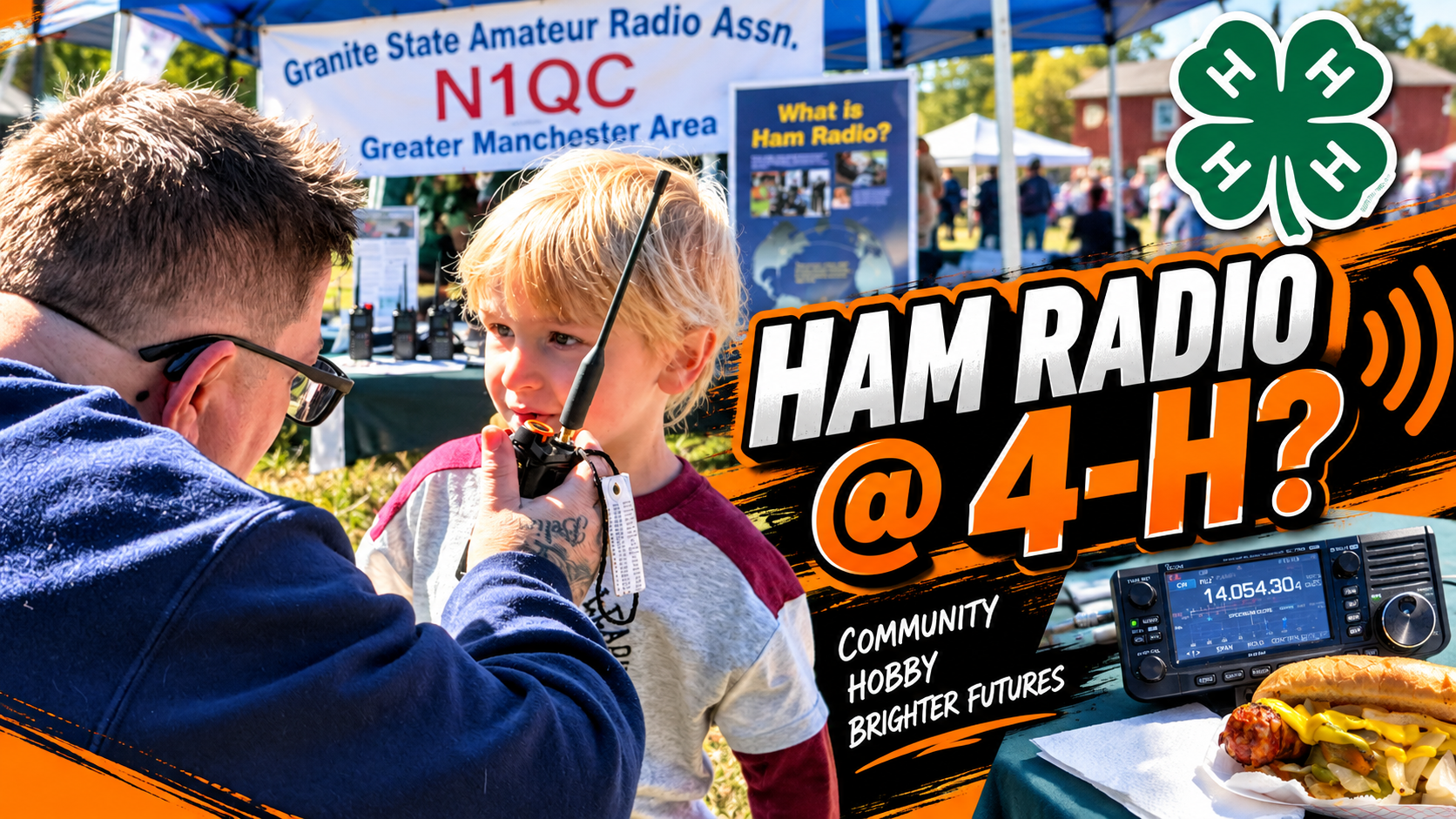
What does ham radio have to do with a tractor pull at a 4-H Agricultural Fair?
Apparently, quite a bit.
Recently, our club set up at a local 4-H fair here in New Hampshire. There were tractors, animals, fair food, families wandering around and, tucked into all of that, a bunch of amateur radio operators with antennas in the air and radios sitting on tables.
And people stopped.
Kids stopped.
Parents stopped.
Families started asking questions.
But the thing I've learned after doing several of these events is that talking about ham radio isn't what gets people interested in ham radio.
Doing ham radio does.
That's a distinction I think more amateur radio clubs need to understand.
We Need to Stop Demonstrating Ham Radio
Okay.
Maybe not completely.
Someone still needs to explain what all this stuff is.
But think about the typical amateur radio public display.
We put a radio on a table.
We surround it with equipment.
Maybe there's a laptop displaying something.
There's an antenna outside.
Then someone walks up and we proceed to explain amateur radio to them for ten minutes.
Frequencies.
Repeaters.
Licensing.
Bands.
Modes.
Emergency communications.
Propagation.
Before long, we've basically created a PowerPoint presentation without the PowerPoint.
Meanwhile, the nine-year-old standing beside their parent has mentally left the building.
At the 4-H fair, we had a much better tool.
The microphone.
A kid could pick up an HT and actually talk to another amateur radio operator through a local repeater.
That's different.
Now radio isn't something some guy with a callsign on his shirt is explaining.
The kid is doing it.
And suddenly there are questions.
"Where is that person?"
"How far away are they?"
"How did my voice get there?"
"Can I do it again?"
Now we have something to work with.
Morse Code Is Better When You Can Touch It
We saw the same thing with Morse code.
You could create a beautiful display explaining the history of CW.
Dots.
Dashes.
Samuel Morse.
Telegraphy.
Radio communication.
Or...
You can put a key in front of a kid and show them how to send their name.
Guess which one gets their attention?
At the fair, kids were able to sit down and actually tap out their names.
That's simple.
It doesn't require an expensive radio.
It doesn't require explaining the entire history of amateur radio.
It gives them something to accomplish.
This is my name in Morse code.
Now they've made something happen.
That's the hook.
Want More Portable Radio Content?
Practical portable operating, POTA discussions, gear reviews, Brew & Activate livestreams, and real-world ham radio content.
Ham Radio Has a STEM Problem We Should Be Able to Solve
One of the strange things about amateur radio is that we're sitting on an incredible collection of STEM activities.
Radio.
Electronics.
Antennas.
Computers.
Digital communications.
Satellites.
Direction finding.
Propagation.
Coding.
Weather.
Emergency communications.
Geography.
You can go unbelievably deep into almost any one of those subjects.
Yet sometimes when we're trying to introduce young people to amateur radio, we start with:
"First, you need to study for this 35-question test."
That's not exactly a killer sales pitch.
The license matters.
Absolutely.
But curiosity should come before licensing.
Give someone a reason to want the license first.
ARRL has been putting more emphasis on this same hands-on connection between amateur radio and STEM. Recent youth programs highlighted by ARRL include antenna construction, transmitter hunting, robotics, solar power, mesh networking and HF communications.
That's the amateur radio I want kids to discover.
Not memorizing the maximum permissible symbol rate on a particular band before they've even had the chance to key a microphone.
Ham Camp Really Drove This Home for Me
The 4-H fair wasn't an isolated experience.
We saw the same thing during the World Academy Ham Radio Summer Camp.
We spent five days with twelve kids learning about radio.
But the important part is that they didn't spend five days listening to us talk about radio.
They used HTs.
They made contacts.
They learned CW.
They worked with APRS.
They learned about antennas.
They built tape-measure Yagis.
Then they used those antennas to hunt transmitters.
And finally, we took them to Silver Lake State Park and put them on HF for a POTA activation.
By the end of the week, students were asking how they could get licensed and receive their own callsigns. The ARRL New England Division's coverage of the camp reached the same conclusion: youth outreach becomes much more compelling when students are allowed to operate, build and experiment rather than simply watch demonstrations.
That's the formula.
Do first. Explain second.
You Don't Need a Week-Long Ham Camp
This is where I don't want clubs to look at what we did and think:
"That's great, Eric, but we can't run a five-day summer camp."
Fine.
Don't.
Start with a table at a community event.
We just did it at an agricultural fair.
ARRL has specifically been encouraging clubs to partner with summer camps and STEM/STEAM programs, and other clubs are finding similar opportunities with schools, museums and community organizations.
You don't need fifteen stations and a trailer full of equipment.
You need a few activities that someone can understand almost immediately.
Put an HT in someone's hand.
Let them make a supervised contact.
Set up two keys and teach families how to send their names in Morse code.
Hide a transmitter and let kids find it.
Put an antenna analyzer on a table and let them change the length of an antenna.
Set up an HF station and find a few operators willing to answer calls.
Show APRS on a map.
Receive an SSTV image.
Track a satellite.
The specific activity isn't nearly as important as this rule:
They should be doing something.
Keep the Conversation Going
What’s one thing you stopped bringing to activations because you realized you never actually needed it? Drop into the Discord and tell the Brew Crew.
Join the N1JUR DiscordYour Club Already Has Most of What It Needs
This might be my favorite part.
Ham clubs love equipment.
We have equipment stored in closets.
Equipment in trailers.
Equipment in garages.
Equipment we're saving because someday someone may apparently require three different generations of Anderson Powerpole crimpers during an emergency.
You probably already own what you need.
What you might not have is the activity built around it.
Instead of asking:
"What equipment should we display?"
Ask:
"What can someone do at our table in five minutes?"
That changes everything.
A radio isn't the exhibit.
Making the contact is the exhibit.
A Morse key isn't the exhibit.
Sending your name is the exhibit.
A Yagi isn't the exhibit.
Finding the hidden transmitter is the exhibit.
That's the shift.
And This Isn't Just About Kids
Something else happened at the 4-H fair.
Adults were interested too.
Parents watched their kids use the radios.
People asked questions.
Families stopped to talk.
Some already knew a little about amateur radio.
Some didn't.
That's why I think calling this simply "youth outreach" almost undersells it.
This is community outreach.
The kid gets excited about Morse code.
Dad starts asking about HF.
Mom remembers that her grandfather had a callsign.
Someone asks what that antenna is.
Someone else asks how far we've talked.
And suddenly you're having a conversation about amateur radio with an entire family.
You couldn't manufacture that interaction with a brochure.
What I'd Do If I Were a Ham Radio Club
I would stop waiting for people to walk into a club meeting.
Go where they already are.
Find your local:
4-H programs
STEM fairs
Libraries
Scouts
Schools
Maker spaces
Museums
Community fairs
Summer camps
Then don't approach them asking for a place where you can promote your club.
Offer them an activity.
"We'd like to bring a hands-on radio communications activity where kids can make supervised radio contacts, learn their names in Morse code and try radio direction finding."
That's a completely different pitch.
You're not asking them to help your club recruit members.
You're offering them programming.
ARRL's 2026 "Year of the Club" messaging has likewise emphasized the role local clubs can play in community building, mentoring and public service, while its recent club guidance specifically encourages partnerships with youth camps and STEM programs.
That door is open.
We just need more clubs walking through it.
The Public Isn't as Uninterested as We Think
This may be the biggest lesson I've taken from these events.
We spend a lot of time inside amateur radio talking about whether people are interested in amateur radio.
Young people don't care.
Nobody wants to talk on radios anymore.
Everyone has a cellphone.
The hobby is aging.
Then we set up at a community event...
And people stop.
They ask questions.
Kids grab microphones.
They pound away at Morse keys.
They hunt transmitters.
They make contacts.
They want to know how it works.
Maybe the public isn't the problem.
Maybe we've been waiting for them to come find us.
Ham radio is difficult to understand from the outside.
A radio sitting on a table doesn't look particularly exciting.
But hand someone the microphone and let a voice come back from another town, another state or another country?
Now they understand.
That's the magic trick.
Except it isn't magic.
It's radio.
Give Them Something to Remember
I don't expect every kid who stops at our booth to become a licensed amateur radio operator.
That's not a realistic measure of success.
Maybe one gets interested in electronics.
Maybe another remembers Morse code.
Maybe someone starts playing with SDR.
Maybe a family looks up amateur radio when they get home.
And maybe one of those kids eventually walks into a VE session and earns a callsign.
We won't always know.
But I do know this:
They're much more likely to remember the day they talked on a radio than the day someone explained one to them.
So if your club is worried about bringing new people into amateur radio, here's my challenge.
Don't schedule another meeting to discuss outreach.
Find a community event.
Bring some radios.
Build three simple activities.
Put the microphone in somebody else's hand.
And let them play radio.
You might be surprised who gets curious.
Like What’s Happening Here?
N1JUR is built around helping more people get active in ham radio through videos, Field Notes, POTA content, live streams, gear reviews, and community.
If you already watch the channel and want to support more of the work behind it, memberships are one way to help keep the signal going.
Videos. Field Notes. Live Streams. Community.
Membership support helps keep the N1JUR ecosystem moving without turning every page into a pledge drive wearing a callsign hat.
Learn About the Community →