
The Best Ham Radio Gear at a Hamfest Isn't What You Came to Buy
You can buy almost anything in amateur radio without leaving your couch.
Need a radio?
Click.
Coax?
Click.
Power supply?
Click.
A suspiciously inexpensive handheld that somehow claims to cover every frequency between DC and your microwave oven?
Definitely click.
So that raises a legitimate question:
Why are we still going to hamfests?
This week I'll be at NEAR-Fest here in New Hampshire, and I've been thinking about that question because we're surrounded by easier ways to buy equipment than we've ever had before.
If a hamfest is nothing more than a place to purchase a radio, the Internet won that fight years ago.
But that's not why I think hamfests still matter.
The best thing about walking through a hamfest isn't finding the radio you already decided you wanted.
It's finding something that makes you stop and say:
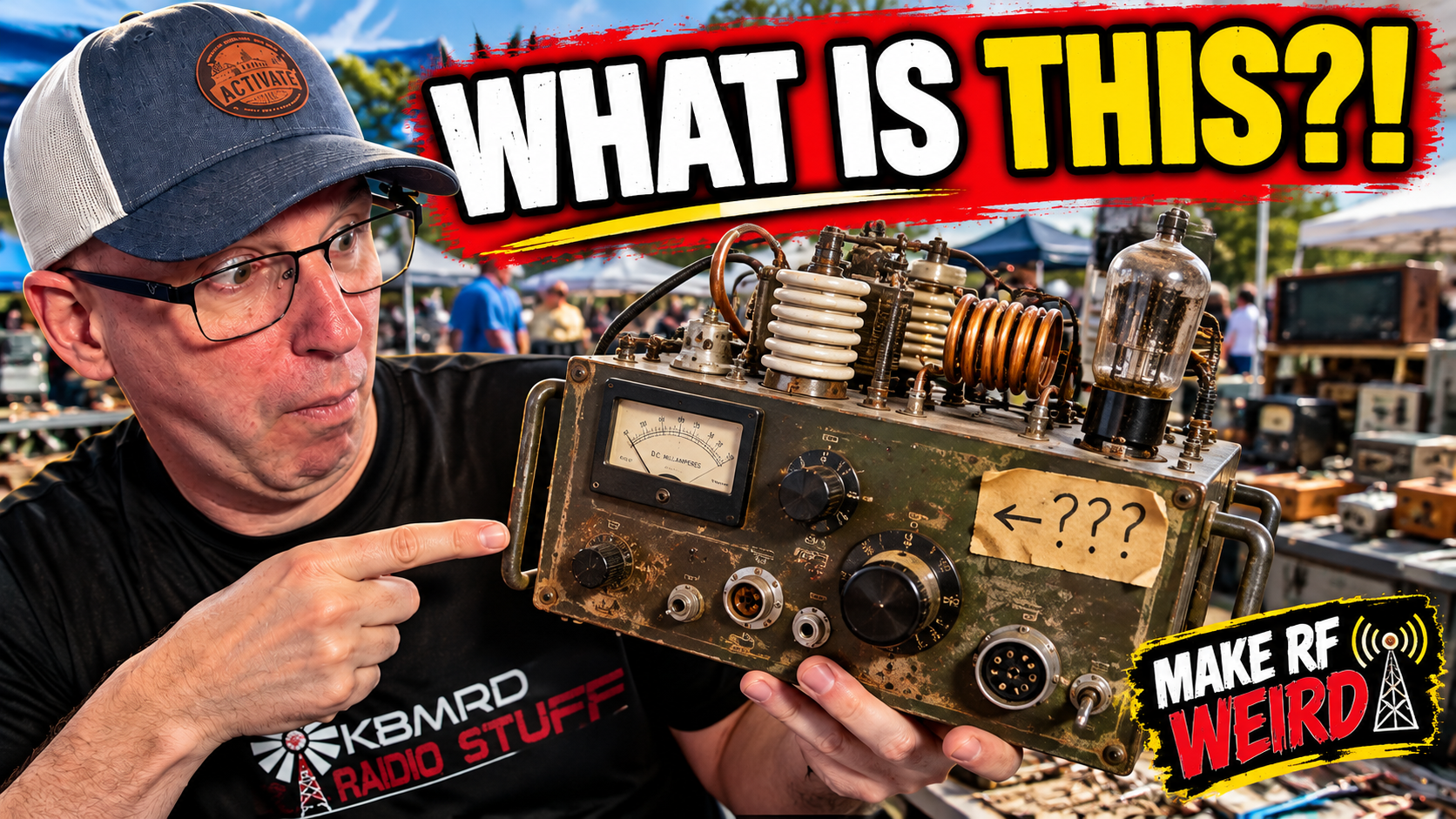
“What the heck is THAT?”
That's where the fun starts.
Hamfests Are Terrible Online Stores
Let's get this out of the way.
If I know exactly what I want, a hamfest probably isn't the most efficient way to buy it.
If I need:
25 feet of a specific coax,
three Powerpole connectors,
a particular mobile mount,
an exact radio model,
or some adapter I forgot to order for the third time,
I can probably find it online before I finish this article.
I can compare prices.
Read specifications.
Watch twelve reviews.
Open seventeen browser tabs.
Spend four hours researching a $14 purchase.
You know.
Normal ham-radio behavior.
A hamfest can't compete with that.
And I don't think it should try.
Because walking through rows of equipment isn't valuable because it's an efficient purchasing system.
It's valuable because it is inefficient.
The Internet Shows You What You Search For
This is something I've been thinking about more lately.
Online shopping is extremely good at helping us find what we already know exists.
Search for an FT-891.
You'll find an FT-891.
Search for a portable antenna.
You'll get approximately 4,700 portable antennas and at least six people explaining why the one you're considering is wrong.
Algorithms are good at narrowing things down.
Hamfests do the opposite.
You're walking past a table and suddenly there's:
An old military handset.
A strange antenna coupler.
A homebrew box with three switches and no labels.
A radio you've never seen before.
A piece of test equipment weighing approximately as much as a Honda Civic.
Some cable with connectors you can't identify.
And inevitably:
A cardboard box marked:
$5 — AS IS
Now we're talking.
You weren't searching for any of it.
That's exactly the point.
Want More Portable Radio Content?
Practical portable operating, POTA discussions, gear reviews, Brew & Activate livestreams, and real-world ham radio content.
Weird Gear Creates Questions
This is the part I think matters.
The most interesting piece of equipment at a hamfest may not be the most valuable.
It may not even work.
But it makes you ask questions.
What did this do?
What frequency was it designed for?
Who used it?
Can it be modified?
Can I make it work with modern equipment?
Why does it have that connector?
Why does it weigh 47 pounds?
Why did I just buy it?
Okay.
That last question usually comes later.
But curiosity is one of the things that keeps amateur radio interesting.
And hamfests are basically warehouses full of RF curiosity.
We Have Become Very Good at Buying Finished Solutions
Modern ham-radio equipment is incredible.
Take it out of the box.
Connect power.
Connect an antenna.
Turn it on.
There are radios today that can do things operators twenty or thirty years ago would have considered absurd.
Touchscreens.
Built-in sound cards.
GPS.
Bluetooth.
Wi-Fi.
Digital modes.
Spectrum scopes.
Automatic tuners.
And that's fantastic.
But there's a downside to equipment becoming easier to use.
Sometimes we stop wondering how any of it works.
Old, odd and homebrew equipment has a way of forcing that question back into the conversation.
Maybe you find an antenna tuner built into an ammunition can.
Maybe someone built a portable station into a toolbox.
Maybe there's a homemade antenna nobody can immediately identify.
Maybe there's some ancient piece of commercial equipment that can be repurposed.
Suddenly you're not shopping anymore.
You're reverse engineering.
That's much closer to the amateur radio I enjoy.
Don't Ask “What Is It Worth?”
At least not first.
Obviously, price matters.
I'm not suggesting you hand somebody $300 because the rusty aluminum box on their table has a BNC connector.
But when I find something strange, I think the better first question is:
What could I do with it?
That's different from:
What's this worth?
One is shopping.
The other is experimenting.
Could that old enclosure become a portable antenna tuner?
Could those meters be reused in a project?
Could the military surplus bag become a POTA kit?
Could that commercial antenna be modified for an amateur band?
Could the weird microphone work with one of your radios?
Could the mystery box become an episode of Break & Build?
And occasionally the answer will be:
No. This is garbage.
That's useful information too.
Put it back.
Slowly.
Make eye contact with nobody.
Continue walking.
Keep the Conversation Going
What’s one thing you stopped bringing to activations because you realized you never actually needed it? Drop into the Discord and tell the Brew Crew.
Join the N1JUR DiscordThe Five-Dollar Box May Be More Interesting Than the $2,000 Radio
The shiny new radios will always get attention.
I understand why.
I like new radios too.
But if I'm walking through a hamfest, the table that gets me curious isn't necessarily the one with equipment I could order tonight.
It's the one where I don't immediately understand everything I'm looking at.
That's the table where somebody says:
“Oh, that thing? We used those for...”
Now you get the story.
And that's another thing the Internet doesn't reproduce particularly well.
Every Weird Piece of Gear Usually Has a Ham Attached to It
Pick something unusual up at a hamfest and there's a good chance someone nearby knows exactly what it is.
Sometimes too exactly.
You ask one question and twenty minutes later you know:
Who manufactured it.
What year they made it.
Why revision B was better than revision C.
What capacitor always fails.
Who used one during Field Day in 1987.
And why you absolutely should not pay the price written on the masking tape.
That's not a product listing.
That's institutional knowledge.
Some of the people walking around these events have been experimenting with RF longer than I've been licensed.
Some longer than I've been alive.
That knowledge doesn't always make it into a manual or YouTube video.
Sometimes it's standing behind a folding table drinking coffee.
That's Why Hamfests Still Matter
Hamfests aren't just marketplaces.
They're one of the few places in amateur radio where the hobby exists physically.
You see the equipment.
You touch it.
You talk to the person who built it.
You meet the club maintaining the repeater.
You find the person you've worked on the air fifty times but have never actually met.
You run into someone you haven't seen since the last hamfest.
You learn about a project.
You discover a mode.
You find a radio you didn't know existed.
And sometimes you walk back to the truck carrying something you absolutely did not need when you arrived.
That's part of it too.
NEAR-Fest XL, for example, isn't just an equipment sale. The October 2–3 event includes a large outdoor flea market, indoor exhibitors, licensing exams, clubs, camping and other amateur-radio activities. Meet Me at the Fair
The flea market may get you through the gate.
The conversations are probably what keep you there.
So I'm Going to NEAR-Fest With a Different Mission
Normally, hamfest videos tend to go something like this:
Walk down aisle.
Point camera at radios.
Walk down another aisle.
Point camera at more radios.
Ask somebody how the hamfest is going.
They say:
“Good.”
Excellent journalism.
I want to try something different.
This time I'm hunting for:
Like What’s Happening Here?
N1JUR is built around helping more people get active in ham radio through videos, Field Notes, POTA content, live streams, gear reviews, and community.
If you already watch the channel and want to support more of the work behind it, memberships are one way to help keep the signal going.
Videos. Field Notes. Live Streams. Community.
Membership support helps keep the N1JUR ecosystem moving without turning every page into a pledge drive wearing a callsign hat.
Learn About the Community →HAM RADIO'S WEIRDEST GEAR
Not the most expensive radio.
Not the rarest radio.
Not necessarily the best deal.
I want the equipment that makes me stop walking.
The homemade stuff.
The forgotten stuff.
The “I haven't seen one of those in twenty years” stuff.
The thing where even the seller has to think for a second before explaining what it does.
The stuff that makes RF weird.
Because every one of those objects has a story.
And probably a project hiding inside it.
My Hamfest Rule: Buy a Question
Here's the rule I'm going to try.
If you're going to buy something weird at a hamfest, don't just buy equipment.
Buy a question.
Something that makes you want to figure something out.
“How can I get this working?”
“Can I modify this for portable use?”
“What happens if I connect this to that?”
“Can I build a better version?”
“Can this become part of my station?”
Now the purchase has somewhere to go.
It becomes a project.
Maybe a video.
Maybe a Break & Build episode.
Maybe something you bring back to the next hamfest and put on your own table with a piece of masking tape that says:
$5 — AS IS
The circle of amateur radio is complete.
What Should a New Ham Look For?
If you're newer to amateur radio, don't feel like you need to recognize everything.
Actually, I think the opposite approach is more fun.
Find something you don't recognize.
Then ask.
Most hams selling equipment are perfectly happy to tell you what something is.
Sometimes very, very happy.
Use that.
Look for inexpensive items that let you experiment without turning the hamfest into a major financial decision.
Connectors.
Meters.
Coax.
Antenna parts.
Enclosures.
Books.
Old accessories.
Hand tools.
Components.
Small homebrew projects.
You don't need to leave carrying a transceiver.
You can leave with a $10 item and a weekend project.
That's a pretty good hamfest.
There Is One Important Rule
We should probably acknowledge this before somebody returns home with a truck bed full of “projects.”
Weird does not automatically mean useful.
Some equipment is obsolete.
Some has been modified badly.
Some is damaged.
Some isn't economically repairable.
Some may involve unsafe voltages.
Some mystery equipment should remain a mystery until you know enough to inspect it safely.
And some things are simply junk.
The goal isn't:
Buy weird garbage.
The goal is:
Stay curious.
There's a difference.
A fairly expensive difference if you don't learn it.
Stop Shopping for a Minute
So if you're headed to NEAR-Fest—or any hamfest—try something.
For one aisle, stop looking for what you came to buy.
Don't hunt for the radio.
Don't compare prices.
Don't check your list.
Just look for something you don't understand.
Then ask somebody about it.
You may discover an old piece of technology.
A new project.
A clever solution.
A piece of amateur-radio history.
Or an object whose primary modern function is apparently holding down the corner of someone's tarp.
Either way, you learned something.
And that may be the real reason hamfests are still worth going to.
We don't need hamfests because we need another place to buy radios.
We need them because they're one of the few places left where amateur radio can surprise us.
So this weekend, I'm going looking for the weird stuff.
Operation: Make RF Weird is officially underway.