
146.52 Is Calling. Is Anybody Listening?
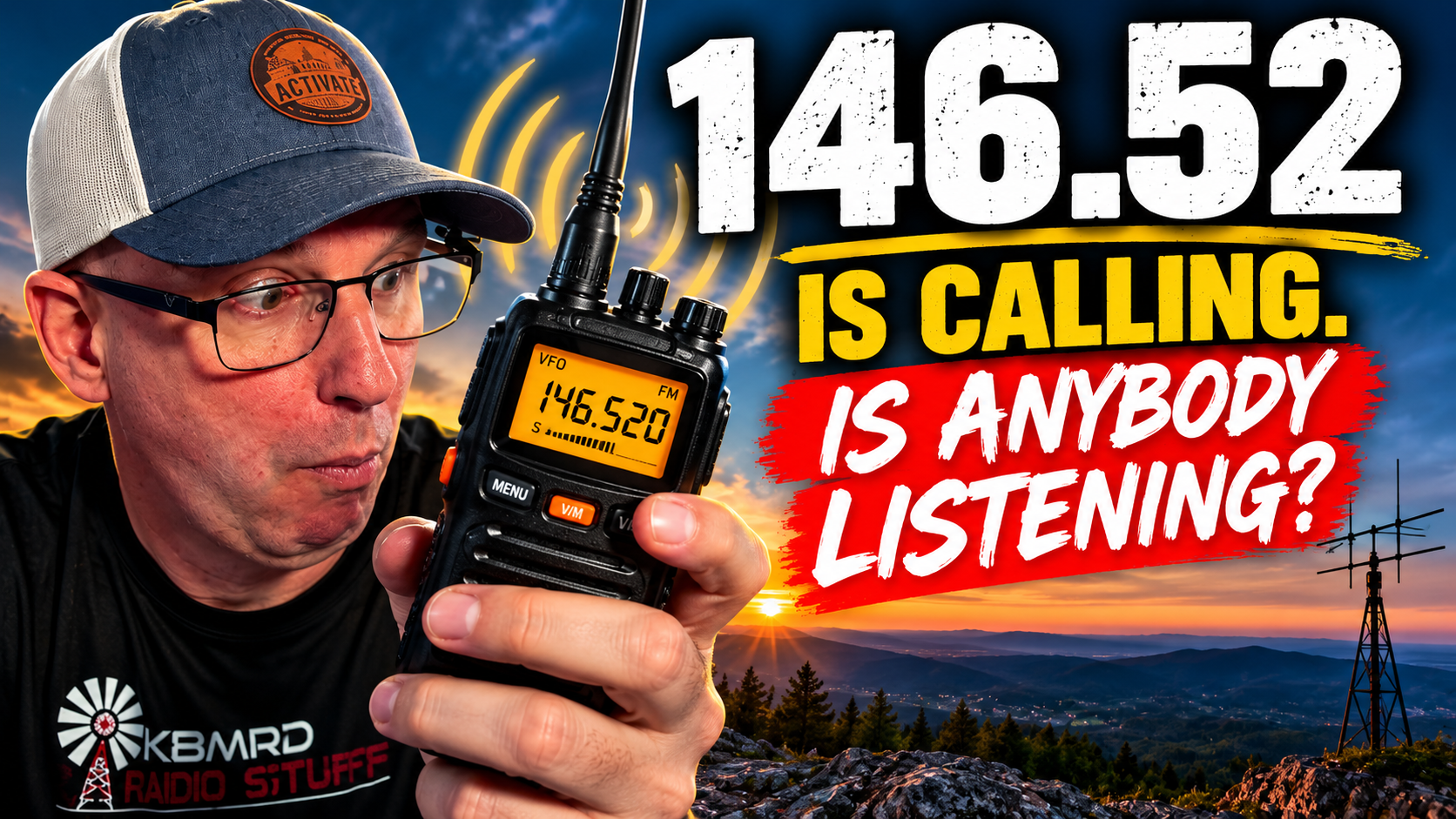
I hear some version of this all the time:
“Two meters is dead.”
“The repeaters are quiet.”
“Nobody talks anymore.”
“I scan 146.52 and never hear anything.”
And maybe you're right.
Maybe nobody is talking.
But I've started wondering whether we have a chicken-and-egg problem.
Because if everybody is listening to 146.52 waiting for somebody else to call...
who exactly is supposed to be doing the calling?
That's what got me thinking about a simple experiment.
Ten minutes.
146.52 MHz.
Every day.
Call CQ.
See what happens.
I call it the 10-52 Simplex Challenge.
And I'm starting to think this little experiment says something much bigger about amateur radio.
First: What Is 146.52 MHz?
If you're newer to amateur radio, let's establish what we're talking about.
146.520 MHz is the national FM simplex calling frequency on the 2-meter amateur band in the United States. ARRL's current 2-meter band plan identifies 146.52 as the national simplex calling frequency, inside the 146.40–146.58 MHz simplex segment. ARRL
Simplex means you're talking radio to radio.
No repeater.
No Internet.
No hotspot.
No linked system.
No tower listening on one frequency and retransmitting you on another.
Your antenna sends RF out.
Somebody else's antenna receives it.
That's it.
Which sounds incredibly basic.
Because it is.
And that's exactly why I think we've forgotten how much fun it can be.
Repeaters Changed Our Expectations
Repeaters are fantastic.
I use them.
I'm involved with clubs that maintain them.
They extend the range of a handheld dramatically and make regional communications practical.
But they also change how we think about VHF.
A new Technician buys an HT.
We immediately start programming repeaters.
Frequency.
Offset.
Tone.
Memory channel.
Maybe a digital mode.
Then they push the button and expect the repeater infrastructure to do the heavy lifting.
Simplex strips all of that away.
Now the questions become:
How high is my antenna?
What's between me and the other station?
How much power am I running?
Where am I physically located?
Would moving twenty feet help?
What happens if I use a better antenna?
What happens if I get outside?
Congratulations.
We just turned a conversation into a radio experiment.
Want More Portable Radio Content?
Practical portable operating, POTA discussions, gear reviews, Brew & Activate livestreams, and real-world ham radio content.
“But Nobody Is On 146.52”
This is the argument I hear most often.
And there's some truth to it.
You can leave a radio monitoring 146.52 and hear absolutely nothing.
I've done it.
But here's the problem:
Listening isn't activity.
Imagine 50 operators scattered around an area.
All 50 have 146.52 programmed into their radios.
All 50 occasionally monitor it.
Nobody transmits because they never hear anyone.
Then all 50 go online and say:
“Simplex is dead around here.”
We may have accidentally created the problem we're complaining about.
Someone has to push the button.
That's Where the 10-52 Challenge Came From
The idea is intentionally simple.
Spend 10 minutes a day for 52 days actively trying 146.52.
Not scanning past it.
Not leaving it quietly playing in the background while you're watching YouTube.
Actually call.
“CQ simplex, CQ simplex, this is N1JUR monitoring 146.52.”
Then listen.
Try again.
Give it ten minutes.
That's it.
I'm not asking anyone to climb a mountain.
I'm not asking you to buy another radio.
I'm definitely not asking you to purchase the newest tactical VHF antenna made from aerospace-grade unobtainium.
Use what you have.
The experiment isn't:
How far can I talk?
The experiment is:
What happens when we actually use the frequency?
Your First Contact Might Surprise You
This is where simplex gets interesting.
Repeaters give us predictable coverage.
Simplex doesn't.
You might work somebody two miles away.
Then one day you're sitting somewhere with a little elevation and someone answers from 25 miles away.
Now you want to know why.
Terrain matters.
Antenna height matters.
Buildings matter.
Your antenna matters.
Your location matters.
VHF can be incredibly local, but “local” can change dramatically depending on where the two stations are.
That's the experiment.
You aren't just making a contact.
You're learning what your station can actually do.
Keep the Conversation Going
What’s one thing you stopped bringing to activations because you realized you never actually needed it? Drop into the Discord and tell the Brew Crew.
Join the N1JUR DiscordYour HT Might Be Better Than You Think
Handheld radios get blamed for a lot.
Sometimes deservedly.
But I think we occasionally confuse an antenna problem with a radio problem.
Take the same HT outside.
Move away from the house.
Get to higher ground.
Try a better antenna.
Suddenly the five-watt radio that supposedly “can't reach anything” starts behaving very differently.
That's a valuable lesson for a new operator.
The FCC exam teaches you that VHF propagation is largely line-of-sight.
Making a simplex contact teaches you what that actually feels like.
There's a difference.
This Is What “License to Learn” Should Look Like
I've written before about whether we're teaching new Technicians the right things.
One of the ideas I keep coming back to is giving every new ham a mission immediately after they get licensed.
Not:
“Congratulations. Here's the repeater list.”
Give them something to discover.
Make a simplex contact.
Build an antenna.
Try a fox hunt.
Listen for a satellite.
Activate a park.
Send an APRS message.
Do something where pressing the button creates another question.
Simplex is almost perfect for that.
You don't need much equipment.
You don't need HF privileges.
You don't need an elaborate station.
You need a 2-meter radio and someone else somewhere within RF range.
The challenge is finding them.
And that challenge is exactly what makes it interesting.
146.52 Is a Calling Frequency
There is one important piece of etiquette here.
146.52 is a calling frequency.
The purpose is to establish contact.
If you and another operator are going to settle into a long conversation, it's courteous to move to another appropriate simplex frequency when practical rather than occupying the national calling frequency indefinitely. ARRL's own 2-meter material specifically recommends moving once contact has been established. ARRL
And there are plenty of other simplex frequencies.
Here in the Northeast, for example, the Eastern Massachusetts ARRL frequency list published September 23 includes numerous FM simplex channels surrounding 146.52, as well as simplex allocations on 70 centimeters, 6 meters and 1.25 meters. Eastern Massachusetts ARRL
So think of 146.52 like the front door.
Knock there.
Then go hang out somewhere else.
There Is Another Reason Monitoring Matters
Most of the time, a call on 146.52 is going to be somebody looking for another ham.
Maybe a traveler.
Maybe a mobile operator.
Maybe somebody testing a radio.
Maybe someone sitting on a summit or at a park.
But occasionally, it can matter considerably more.
ARRL documented a 2024 incident in Idaho where an amateur operator used 146.52 MHz to call for help after a serious four-wheeler accident in an area without cellular coverage. Another ham heard the call and contacted 911 while continuing to relay information. ARRL
I'm not suggesting we turn every HT into an emergency-monitoring station.
But it demonstrates something important.
A calling frequency is useful because people know where to call.
That only works when somebody occasionally listens.
Like What’s Happening Here?
N1JUR is built around helping more people get active in ham radio through videos, Field Notes, POTA content, live streams, gear reviews, and community.
If you already watch the channel and want to support more of the work behind it, memberships are one way to help keep the signal going.
Videos. Field Notes. Live Streams. Community.
Membership support helps keep the N1JUR ecosystem moving without turning every page into a pledge drive wearing a callsign hat.
Learn About the Community →Maybe Our Radios Are Too Quiet Because We Are
This is the larger point.
Amateur radio has an interesting habit.
We complain that something isn't being used.
Then we stop using it because nobody is using it.
Repeaters.
Simplex.
Club meetings.
Nets.
Local events.
Someone eventually has to go first.
That's really what this challenge is about.
Not 146.52.
Not ten minutes.
Not 52 days.
Participation.
What happens if instead of asking whether the frequency is active...
we make it active?
Imagine 100 Hams Trying This
This is where the experiment gets fun.
One person calling simplex every day may not change much.
But imagine 100 operators doing it.
Someone commuting home calls.
Someone walking the dog has an HT.
Someone is sitting at a POTA activation.
Someone is testing a mobile radio.
Someone just installed a new antenna.
Someone is driving through town.
Now contacts start happening.
Then people start recognizing callsigns.
Maybe somebody discovers another operator lives three miles away.
Maybe two people start testing antennas.
Maybe somebody realizes they can make the local repeater from the basement but can work simplex twenty miles from the top of a nearby hill.
Now we're experimenting again.
That's ham radio.
You Don't Need Another Piece of Gear
This may be my favorite part of the whole thing.
The 10-52 Challenge probably doesn't require you to buy anything.
You likely already own the radio.
You already have the frequency.
There is no registration.
There is no award you desperately need to laminate.
There is no leaderboard.
Nobody cares whether your HT cost $25 or $500.
Just turn the radio on.
Call.
Listen.
Repeat tomorrow.
That's it.
Try It for Ten Minutes
So here's my challenge.
Put 146.520 MHz into your radio.
If you're mobile, use your mobile station.
If you're home, try the base antenna.
If you're walking, bring the HT.
If you're sitting at a park, listen while you're setting up your HF station.
Give it ten minutes.
Call a few times.
See what happens.
Maybe nobody answers.
That's data.
Try again tomorrow.
Maybe on day seven somebody comes back.
Maybe they're half a mile away.
Maybe they're twenty miles away.
Maybe they're another ham who has been listening to 146.52 for the last six months wondering exactly the same thing you were:
Is anybody out there?
Turns out there was.
Neither of you was pushing the button.