
Your Phone Has No Signal; Your POTA Activation Isn't Over.
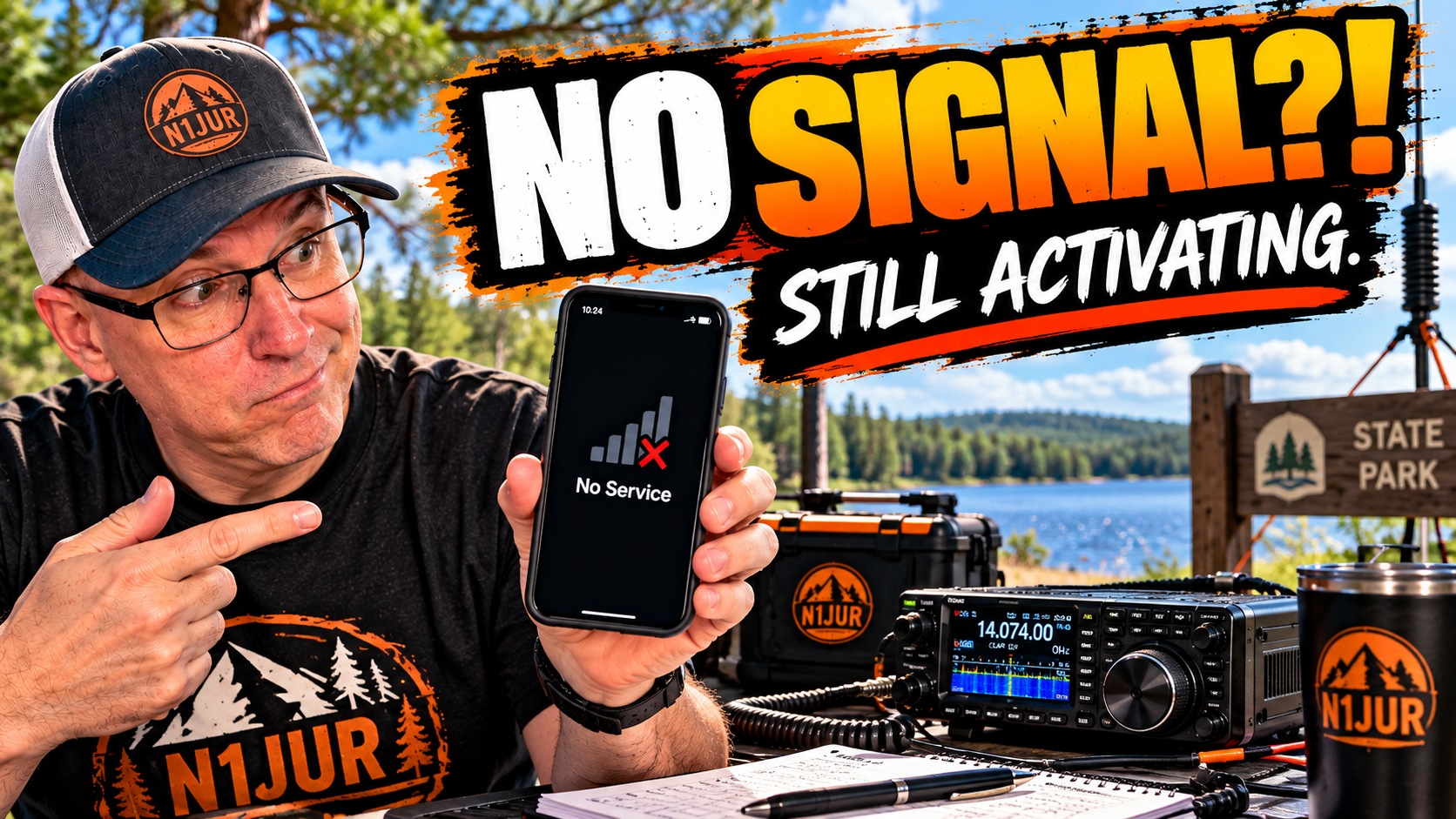
You get to the park.
The radio is ready. Antenna is up. Battery is charged.
Then you pull out your phone.
No Service.
No POTA spotting page. No online map. No callsign lookup. Maybe even your logging workflow suddenly looks questionable.
For an activity built around communicating without traditional infrastructure, we've become surprisingly accustomed to having an Internet connection sitting beside the radio.
So here's the question:
Can you actually activate POTA without the Internet?
Absolutely.
And I think every activator should try it at least once.
Internet Makes POTA Easier. It Doesn't Make POTA Work.
The official POTA rules are pretty straightforward.
A successful activation requires at least 10 qualifying QSOs from an eligible park during a single UTC day. Activators then submit their logs in ADIF format. Spotting is useful, but it isn't what makes an activation valid. Parks on the Air Documentation
That's an important distinction.
We use the Internet to find parks, navigate, spot ourselves, look at propagation, log contacts and eventually upload those contacts.
Those tools are fantastic.
But somewhere along the way, the conveniences can start feeling like requirements.
They're not.
Your radio doesn't care whether your phone has four bars.
Neither does your antenna.
The Biggest Difference Is Getting Found
This is probably where you'll notice the Internet disappearing first.
Normally, you find a frequency, spot yourself and suddenly hunters know exactly where you are.
Take away the spot and things may get quieter.
Now you're relying on operators actually finding you.
Remember doing that?
Turn the VFO. Listen. Call CQ.
You may need to call longer than you're accustomed to. You might need to try another band. You'll probably have to pay more attention to what the band is actually doing instead of assuming the spotting page will deliver a pileup.
There is another option.
Ask someone to spot you.
POTA's rules allow anyone, including hunters, to spot or re-spot an activator. Parks on the Air Documentation
So if someone answers your CQ, finish the contact and ask:
"Would you mind spotting me? I don't have Internet access at the park."
One radio contact could suddenly bring the hunters.
And if nobody spots you?
Keep calling.
That's where the experiment gets interesting.
Want More Portable Radio Content?
Practical portable operating, POTA discussions, gear reviews, Brew & Activate livestreams, and real-world ham radio content.
Make Sure Your Logger Actually Works Offline
This is something I'd test before driving to a park with no cell service.
Turn off Wi-Fi and cellular data.
Open your logging application.
Enter a couple of fake test contacts.
Close it.
Open it again.
Can you still see them?
Can you eventually export a valid ADIF file?
If so, great.
If not, you just learned something useful while sitting at home instead of halfway through an activation.
POTA's own Activator Guide recognizes both computer and paper logging. It specifically recommends testing logging software with simulated QSOs and checking its exported ADIF before depending on it. Parks on the Air Documentation
And there is always the most technologically advanced logging system ever developed:
Paper and a pencil.
It doesn't need cellular service.
It doesn't need Bluetooth.
It doesn't need charging.
And it has never once decided to install an update as you were calling CQ.
You'll have to enter the contacts later, but that's perfectly workable. POTA ultimately needs a valid ADIF file for submission; you don't need to create that file while sitting in the park. Parks on the Air Documentation
Try the Airplane Mode Activation
This is where I'd turn the article into a challenge.
Pick a POTA park you already know.
Do your homework before leaving. Verify the park and boundaries, save whatever information or maps you'll need offline, and make sure your equipment and logging system are ready.
Then, once you're safely at the park:
Put the phone in airplane mode.
Now activate.
No checking spots.
No propagation website.
No online callsign lookup.
No rescuing the activation with Google.
Just operate.
Find a frequency. Listen first. Call CQ. Work whoever finds you. Ask your first contact for a spot if you want to see whether that changes things.
And keep a good log.
The goal isn't to pretend the Internet is bad.
I like the spotting page.
I like electronic logging.
I like being able to look something up when I need it.
The point is discovering which parts of your station depend on the Internet without you realizing it.
That's useful information.
What If You Don't Get Ten?
Maybe you get twelve contacts.
Maybe you get thirty.
Or maybe after an hour you have six.
Technically, fewer than ten qualifying QSOs won't produce a successful POTA activation for that UTC day. POTA still asks activators to submit unsuccessful logs so the hunters they worked receive their credit. Parks on the Air Documentation
But I wouldn't call the experiment a failure.
Maybe you discovered your logging app isn't really offline.
Maybe you learned that you depend heavily on self-spotting.
Maybe you became more comfortable calling CQ without immediately getting answers.
Maybe you had to read the band and change tactics.
That's operating.
And that's really why I like this experiment.
Keep the Conversation Going
What’s one thing you stopped bringing to activations because you realized you never actually needed it? Drop into the Discord and tell the Brew Crew.
Join the N1JUR DiscordConvenience Is Great. Dependence Isn't.
I'm not giving up my smartphone.
I'm not going back to paper logs for every activation.
And I'm certainly not suggesting we should make POTA harder simply because we can.
But there's value in knowing what happens when one piece of your normal system disappears.
Portable amateur radio is supposed to be portable because we bring what we need to make the station work.
Maybe it's worth finding out whether we've accidentally added a cell tower to the equipment list.
Try one activation without it.
You may discover your station works just fine.
And you might spend a little less time staring at your phone and a little more time playing radio.
Make RF. Not excuses.
Like What’s Happening Here?
N1JUR is built around helping more people get active in ham radio through videos, Field Notes, POTA content, live streams, gear reviews, and community.
If you already watch the channel and want to support more of the work behind it, memberships are one way to help keep the signal going.
Videos. Field Notes. Live Streams. Community.
Membership support helps keep the N1JUR ecosystem moving without turning every page into a pledge drive wearing a callsign hat.
Learn About the Community →