
The Most Important Piece of POTA Gear Isn't in Your Bag
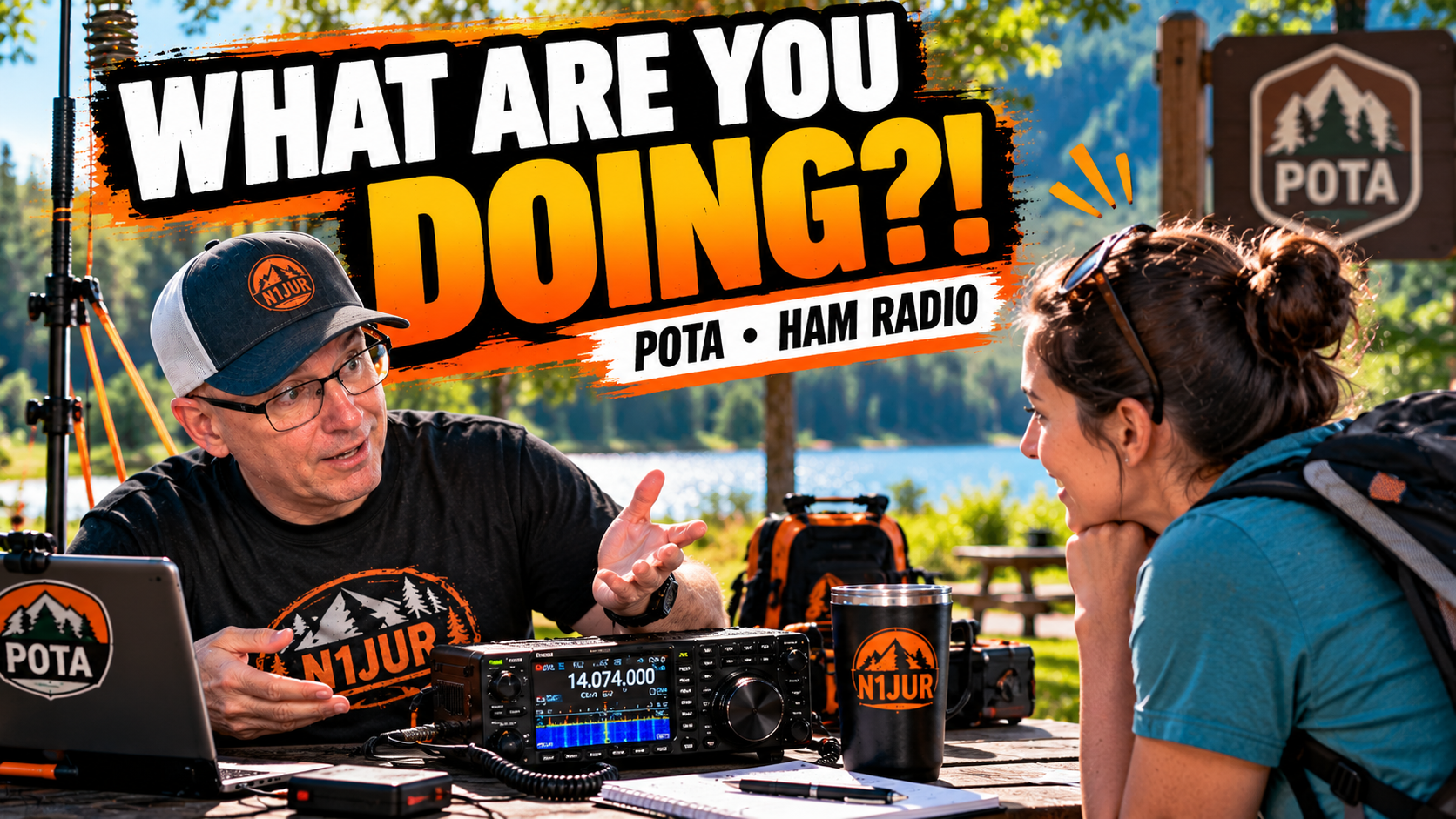
We spend a ridiculous amount of time thinking about what goes into our POTA bags.
Radios. Antennas. Batteries. Coax. Logging devices. Spare adapters. And probably another adapter because we don't trust the first one.
But there's something you might need during your next activation that you can't buy from a ham-radio retailer.
The ability to explain what you're doing to someone who has absolutely no idea what amateur radio is.
Because sooner or later, someone is going to walk past your station, look at the antenna, and ask:
"What are you doing?"
And how you answer might be more important than the next ten contacts in your log.
Your Station Looks Different to Everyone Else
To us, a portable radio station makes perfect sense.
There's a radio on the table, an antenna somewhere nearby, and maybe a laptop keeping track of contacts.
Normal stuff.
To someone walking through the park?
You might look like you're tracking satellites, conducting a science experiment, or communicating with another planet.
But here's the interesting part.
They stopped because something caught their attention.
That's an opportunity to introduce someone to a hobby they might never have encountered otherwise.
And you don't need to turn it into a twenty-minute presentation.
Want More Portable Radio Content?
Practical portable operating, POTA discussions, gear reviews, Brew & Activate livestreams, and real-world ham radio content.
Keep the Explanation Simple
When someone asks what you're doing, it's tempting to explain everything.
HF propagation. Antenna resonance. Power output. The ionosphere. POTA rules.
Before you know it, you've explained three license classes and the history of amateur radio, and the person is slowly backing away toward the parking lot.
Instead, try this:
"I'm using amateur radio to talk with people in other places, sometimes hundreds or thousands of miles away, without using the Internet or cell service."
That's it.
If they're curious about the park, explain that Parks on the Air is an activity where operators visit parks and make radio contacts with other operators.
Then let them ask the next question.
Maybe they want to know how far your signal travels.
Maybe they're curious about the antenna.
Or maybe they just want to know who you're talking to.
Answer the question they asked, not the five questions you wish they'd asked.
Let Them Experience Something
This was one of the things we recently discussed on Brew & Activate.
Sometimes the best way to explain amateur radio isn't to explain it at all.
It's to let someone hear it.
If it's safe and practical, invite a curious visitor to listen to a contact.
Maybe they hear someone from another state coming through the speaker.
You can explain what's happening:
"That operator is in Ohio. We're talking directly over radio, and I'm writing down their callsign so I can record the contact."
Suddenly, the antenna isn't just a wire hanging from a tree.
The radio isn't just a mysterious box with knobs.
It's a way to communicate.
You don't need to teach them everything about the hobby.
Just give them one experience that makes them curious about the next one.
Keep the Conversation Going
What’s one thing you stopped bringing to activations because you realized you never actually needed it? Drop into the Discord and tell the Brew Crew.
Join the N1JUR DiscordYou're Still There to Activate
Of course, you're at the park to operate.
Maybe you've got a pileup going. Maybe the band finally opened. Or maybe you're trying to squeeze in ten contacts before the weather changes.
You don't have to stop everything for a full demonstration.
Something as simple as:
"Thanks for stopping by! I'm making radio contacts with people around the country. You're welcome to listen for a minute."
And when it's time to get back to operating:
"Thanks for checking it out. I'm going to get back to the folks calling me."
Friendly. Simple. No awkwardness.
Remember that you're sharing a public space, too. Keep your setup safe and approachable, and respect people who aren't interested.
One Conversation Might Be Worth More Than Ten QSOs
I enjoy a good POTA pileup as much as anybody.
But one of the things I appreciate about portable operating is that we're taking amateur radio out where people can actually see it.
Maybe the person who stops never gets licensed.
Maybe they tell someone about what they saw.
Or maybe they become the person sitting at a park table with their own radio someday.
We don't know.
But it starts with being approachable.
So before your next activation, make sure you've packed the essentials.
Radio. Antenna. Battery. Logging setup.
And one simple explanation of what you're doing.
The last one doesn't take up any room in your bag.
Like What’s Happening Here?
N1JUR is built around helping more people get active in ham radio through videos, Field Notes, POTA content, live streams, gear reviews, and community.
If you already watch the channel and want to support more of the work behind it, memberships are one way to help keep the signal going.
Videos. Field Notes. Live Streams. Community.
Membership support helps keep the N1JUR ecosystem moving without turning every page into a pledge drive wearing a callsign hat.
Learn About the Community →