
The New Technician Question Pool: Are We Teaching the Right Things?
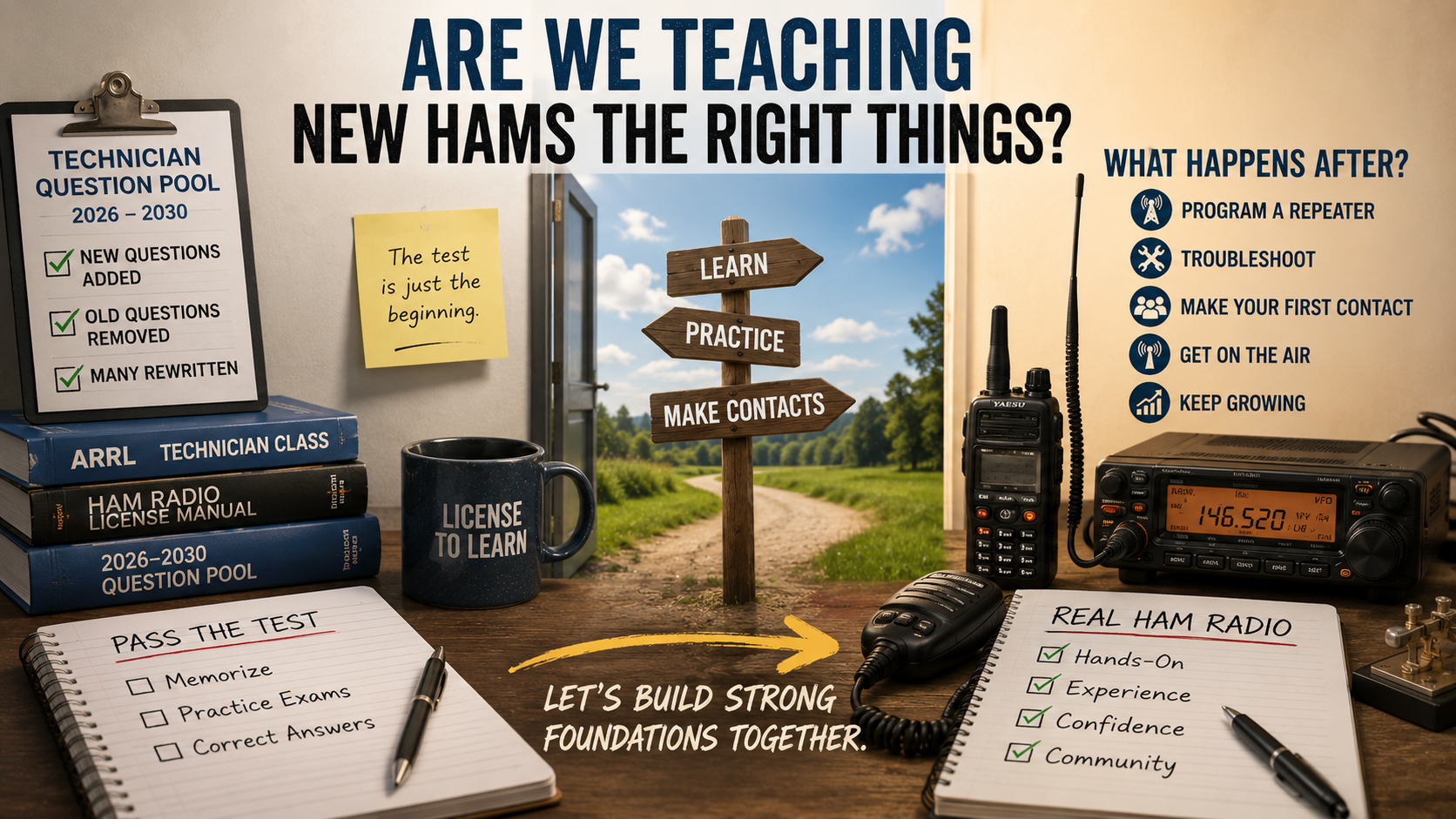
Every four years, the Technician question pool changes.
Questions get updated.
Old material gets removed.
New technology gets added.
Study guides get rewritten.
Instructors replace their slides.
And thousands of future hams start memorizing a slightly different collection of answers.
The new 2026–2030 Technician question pool became effective on July 1, 2026. It includes 409 questions, with 27 new questions, 30 removed, and roughly 155 modified.
That sounds like a significant update.
But I think it raises a bigger question.
Are we teaching new operators the right things?
More importantly, are we giving them the foundational skills they need to grow after they pass the test?
Because we say the Technician license is a “license to learn.”
I agree with that.
But a license to learn still needs to give someone a reasonable place to start.
Passing the Test Is Not the Same as Learning Ham Radio
Let’s be honest about how many people prepare for the Technician exam.
Download an app.
Read the question.
Tap the answer.
Repeat until the green percentage says they are ready.
There is nothing inherently wrong with that.
Practice exams are useful.
Flash cards are useful.
Seeing the actual question pool makes the test less intimidating.
And if someone studies hard enough to pass, they have completed the requirement.
They earned the license.
The problem is that passing the exam and understanding amateur radio are not necessarily the same thing.
Someone can memorize that a repeater offset exists without knowing how to program one into a radio.
They can identify the correct electrical formula without knowing how to calculate whether a battery will last through an activation.
They can answer a question about RF exposure without understanding how it affects their actual antenna installation.
They can identify a schematic symbol but have no idea what to do when the radio will not turn on.
The exam measures whether someone can select the correct answers.
It does not always measure whether they can use the information.
“It’s a License to Learn” Can Become an Excuse
I hear this phrase all the time.
“The Technician license is just a license to learn.”
And again, I agree with the basic idea.
Nobody should be expected to understand the entire hobby before receiving an entry-level license.
That would be ridiculous.
Amateur radio is too broad.
You could spend decades learning about antennas, propagation, satellites, digital modes, contesting, emergency communications, microwave, RF design, and everything else hiding in this hobby.
You are never really finished learning.
Keep the Conversation Going
What’s one thing you stopped bringing to activations because you realized you never actually needed it? Drop into the Discord and tell the Brew Crew.
Join the N1JUR DiscordBut sometimes we use “license to learn” as an excuse for not teaching enough before the test.
A student asks how repeaters actually work.
“That will make sense after you get licensed.”
They ask how to choose a first radio.
“You’ll figure that out later.”
They ask how to make their first contact.
“Someone at the club will help you.”
Maybe.
Or maybe they pass the exam, buy an inexpensive handheld, listen to an empty repeater for three days, and put the radio in a drawer.
A license to learn only works when there is a learning path on the other side.
What Should a Technician Actually Be Able to Do?
This is where I think the conversation gets uncomfortable.
What is the minimum practical skill set a new Technician should have?
Not the minimum information required to pass.
The minimum skill set needed to participate.
I think a newly licensed Technician should have at least some idea how to:
Identify the bands and frequencies they are permitted to use.
Program and use a local repeater.
Make a basic simplex contact.
Give their callsign correctly.
Understand basic operating etiquette.
Connect a radio, power source, feed line, and antenna safely.
Recognize when an antenna system may present a problem.
Understand the difference between listening, transmitting, and actually being heard.
Know where to find reliable help.
They do not need to be experts.
They do not need to derive every formula from memory.
They do not need to build a radio from a pile of components before they are permitted to say hello on a repeater.
But they should leave the licensing process with enough confidence to turn on a radio and do something.
That seems like a reasonable goal.
We Teach Facts Without Always Teaching Context
The Technician pool covers a wide range of subjects.
Rules.
Operating procedures.
Electrical principles.
Components.
Station equipment.
Antennas.
Propagation.
Safety.
That breadth is necessary.
The license grants access to a broad range of amateur-radio activities, so the exam has to touch many topics.
The challenge is context.
A question might teach someone that a certain antenna polarization is commonly used for local VHF communication.
Fine.
But why?
What happens when one station uses vertical polarization and the other uses horizontal?
When would horizontal polarization make sense?
How does that knowledge affect the antenna someone puts on their vehicle?
The correct answer gets someone through the exam.
The context helps them use the information.
We are very good at teaching people what answer to select.
We are not always as good at showing them why the answer matters.
The Question Pool Is Not a Curriculum
This distinction matters.
The question pool is a testing resource.
It is not supposed to be a complete amateur-radio education.
It establishes the subjects that may appear on the exam and provides the exact questions and answers used to build it.
That does not mean an instructor has to teach only those questions.
Unfortunately, many courses are structured that way.
Question.
Correct answer.
Brief explanation.
Next slide.
The goal becomes passing the exam as quickly as possible.
That approach can produce new licensees.
It does not always produce new operators.
A good class should use the question pool as a framework, not the entire curriculum.
Teach the answer.
Then connect it to a radio.
Show the connector.
Demonstrate the setting.
Build the cable.
Make the contact.
Let the student hear what the concept sounds like on the air.
The test should be part of the learning process.
It should not be the entire experience.
Want More Portable Radio Content?
Practical portable operating, POTA discussions, gear reviews, Brew & Activate livestreams, and real-world ham radio content.
Memorization Is Not the Enemy
I want to be careful here.
There is a tendency to criticize anyone who uses practice tests or memorizes portions of the question pool.
I do not think that is fair.
Everyone memorizes something.
Band edges.
Callsigns.
Phonetics.
Repeater frequencies.
Menu locations.
The formulas we use often enough eventually become memory.
Memorization can help someone get started.
The problem is memorization without application.
A person can memorize Ohm’s Law for the test.
That is fine.
Now show them how it helps choose a fuse.
Show them how voltage, current, and power affect a portable station.
Show them why a mobile radio should not be connected through a tiny accessory socket.
Suddenly the formula is no longer just a test question.
It solves a problem.
That is how foundational knowledge begins to stick.
New Hams Don’t Know What They Don’t Know
Experienced operators sometimes forget how confusing the hobby looks from the outside.
We talk about PL tones, offsets, CTCSS, SWR, impedance, HTs, mobiles, HT-to-mobile adapters, coax loss, duty cycles, power supplies, digital voice, and hotspots as though these are normal words.
To us, they are.
To a new operator, it can sound like we are assembling furniture using instructions written by an electrical engineer.
The Technician exam introduces many of these concepts.
But introduction is not the same as understanding.
A new ham may know that SWR is connected to antenna matching.
They may not know what an SWR meter looks like.
They may know that repeaters use separate transmit and receive frequencies.
They may not know which frequency appears on their radio display.
They may know that handheld radios use limited power.
They may still expect the stock antenna to reach every repeater listed online.
This is not the new operator’s fault.
They are new.
Our job should be to turn isolated facts into a working mental model of the station.
We May Be Teaching Too Much—and Not Enough
This is the strange part of the Technician exam.
In some ways, it teaches a lot.
Rules.
Electronics.
Operating.
Safety.
Antennas.
Digital communication.
Satellites.
A new student has to move across a huge amount of material.
But in other ways, it may not teach enough of the things they need during their first week as a ham.
How do I find local activity?
How do I program my radio?
What should I say when someone answers?
Why can I hear the repeater but not reach it?
What antenna should I buy?
What is a realistic range for this handheld?
How do I know whether my station is working?
Where can I operate legally and responsibly?
Those practical questions determine whether a new licensee becomes an active operator.
The exam cannot test every real-world situation.
But our training programs can prepare people for them.
The Test Should Open the Door, Not Become the Destination
There is a major push in amateur radio to make licensing faster and easier.
I understand why.
We want more people in the hobby.
We do not want the test to become an unnecessary barrier.
We do not need to recreate the days when people had to prove themselves worthy of joining some secret radio society.
But the answer cannot simply be:
“Memorize these answers, pass the exam, and good luck.”
That creates licensees who have the legal authority to transmit but no confidence to use it.
The exam should open the door.
Training should help them walk through it.
Give Every New Technician a First Mission
I think one of the best things we could do is give every new Technician a practical mission immediately after they pass.
Not six months later.
Not when they finally build enough confidence to attend a club meeting.
Immediately.
Program a local repeater.
Make a scheduled contact with an instructor or mentor.
Try a simplex contact.
Participate in a net.
Attend a fox hunt.
Use a handheld Yagi.
Listen to a satellite pass.
Visit a POTA activation.
Build a basic antenna.
Do something that turns the license into an experience.
That first success matters.
The moment someone hears their callsign come back through a repeater, the hobby becomes real.
The moment they make a simplex contact farther than expected, they start asking about antennas.
The moment they hear a satellite, they start wondering how orbit prediction works.
Activity creates curiosity.
Curiosity creates learning.
Clubs Need to Become the Second Half of the Class
The licensing course should not end when the exam is graded.
That should be the transition point.
The first half teaches enough to earn the license.
The second half teaches how to use it.
Clubs could offer a simple post-license program:
Week One: Program and use the radio.
Week Two: Repeaters, simplex, and operating etiquette.
Week Three: Antennas, SWR, and basic station troubleshooting.
Week Four: Explore one activity—POTA, satellites, digital modes, fox hunting, or public service.
It does not need to become another eight-week lecture series.
Make it hands-on.
Put radios in front of people.
Let them make mistakes in a supportive environment.
Let them ask the questions they did not know how to ask before passing the exam.
That is where good operators are built.
Mentors Need to Teach Without Showing Off
This is another area where we can lose people.
A new ham asks a simple question.
Instead of giving a simple answer, an experienced operator delivers a 45-minute lecture involving transmission-line theory, Smith charts, and a radio they owned in 1978.
Technically correct.
Completely useless to the person asking how to reach the repeater.
Foundational teaching means meeting someone where they are.
Answer the question they asked.
Give them enough information to take the next step.
Then let the next question come naturally.
We do not prove our knowledge by overwhelming someone.
We prove it by helping them understand.
We Should Measure Activity, Not Just Licenses
Amateur radio often celebrates licensing numbers.
How many people passed?
How many new licenses were issued?
How many students attended the class?
Those are useful numbers.
But I would also like to know:
How many were active six months later?
How many made a contact?
How many joined an event?
How many upgraded?
How many built or improved a station?
How many found an area of the hobby they genuinely enjoy?
The goal should not be to produce the largest possible number of callsigns.
The goal should be to produce operators.
A person who passes the Technician exam but never turns on a radio does not strengthen the hobby very much.
A person who passes, receives support, finds an interest, and starts participating might remain active for decades.
Are We Teaching the Right Things?
The new Technician pool includes updated material, and that is important.
Technology changes.
Operating practices change.
The hobby changes.
The exam should evolve with it.
But changing questions does not automatically improve education.
The larger issue is how we teach the material.
Are we teaching students to recognize answers?
Or are we helping them understand a station?
Are we preparing them to pass a 35-question exam?
Or are we preparing them to make their first contact?
It does not have to be one or the other.
We can keep the entry-level license accessible while still building stronger foundational skills.
We can celebrate someone passing the exam while admitting that the learning has only begun.
We can call it a license to learn while giving them enough knowledge to know what they should learn next.
Like What’s Happening Here?
N1JUR is built around helping more people get active in ham radio through videos, Field Notes, POTA content, live streams, gear reviews, and community.
If you already watch the channel and want to support more of the work behind it, memberships are one way to help keep the signal going.
Videos. Field Notes. Live Streams. Community.
Membership support helps keep the N1JUR ecosystem moving without turning every page into a pledge drive wearing a callsign hat.
Learn About the Community →A License to Learn Still Needs a Foundation
No Technician will leave an exam knowing everything.
They should not.
That is not the purpose of an entry-level license.
But they should leave with more than a callsign and a shopping list.
They should understand the basic pieces of a station.
They should know how to operate safely and legally.
They should know how to ask for help.
And ideally, they should already have a plan for getting on the air.
The new question pool may determine what appears on the test through 2030.
What happens after the test is still up to us.
The instructors.
The clubs.
The mentors.
The experienced operators.
We can hand someone a license and tell them to start learning.
Or we can stand beside them, turn on a radio, and help them make the first contact.
That second approach takes more work.
But it might also help new hams grow faster, stay active longer, and become the operators who eventually teach the next group.
Passing the test gets someone through the door.
A good foundation gives them somewhere to go.
Now let’s help them get on the air.
And go play radio.