
Are Cheap Chinese Radios Good for Ham Radio?
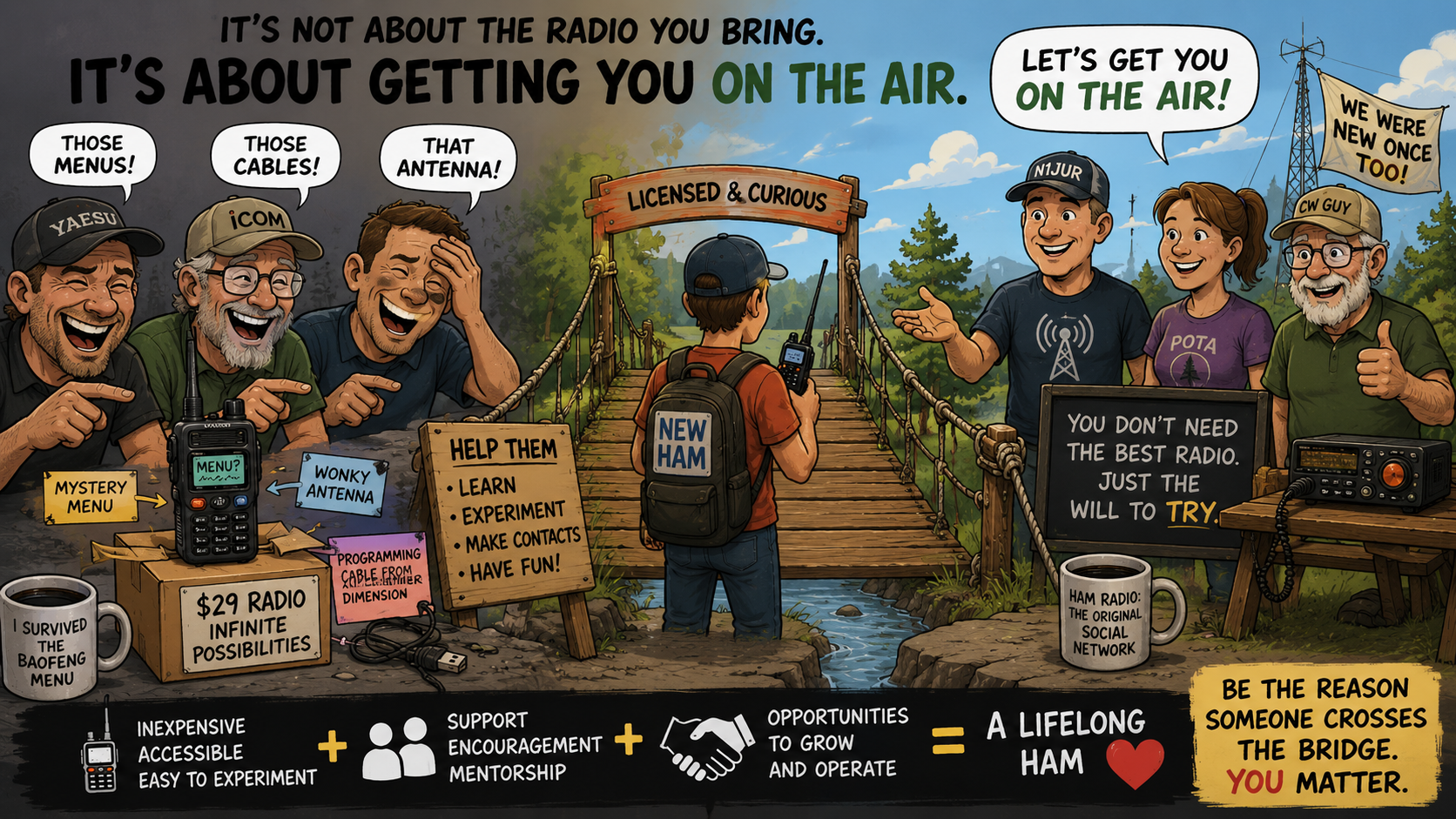
Let’s talk about cheap Chinese radios.
You know the ones.
Small.
Colorful.
Usually less expensive than dinner for two.
They arrive in a box with a charger, an earpiece nobody has ever successfully used, and an instruction manual that appears to have been translated through six languages before reaching English.
And somehow…
Almost every ham owns at least one.
They might not admit it.
They might keep it hidden in a drawer underneath the expensive Japanese radios.
But it’s there.
A Baofeng.
A Quansheng.
A Tidradio.
A Radioddity.
Some small handheld that cost less than the antenna mounted on the roof of their truck.
So are these radios good for ham radio?
That depends on what we mean by good.
They’re Cheap
Let’s start with the obvious.
These radios are inexpensive.
Really inexpensive.
For the cost of a decent dinner, someone can buy a radio, charge it, and start listening.
That matters.
Amateur radio already has enough barriers.
There’s a test.
There’s licensing.
There are frequencies, offsets, tones, repeaters, antennas, programming cables, software, and at least one person at the club meeting who wants to explain all of it before you’re allowed to touch the radio.
Then the new operator looks at the price of a premium handheld.
Three hundred dollars.
Four hundred dollars.
Sometimes more.
That can be a difficult first step for someone who isn’t even sure they’re going to enjoy the hobby.
A $25 or $40 radio changes that equation.
It lowers the risk.
It lets someone experiment.
It creates an easier entry point.
And whether we like it or not, that accessibility has probably brought a lot of people into amateur radio.
Keep the Conversation Going
What’s one thing you stopped bringing to activations because you realized you never actually needed it? Drop into the Discord and tell the Brew Crew.
Join the N1JUR DiscordEvery Ham Has a Baofeng Story
Cheap handhelds have become their own category of amateur radio folklore.
Someone always knows a guy who worked a repeater 40 miles away with a stock antenna.
Someone else claims their radio transmitted on every frequency except the one displayed on the screen.
Another operator replaced the antenna, battery, charger, speaker microphone, belt clip, and programming cable…
At which point they had spent more than the radio cost.
There are also operators who have owned the same UV-5R for ten years.
It has been dropped.
Rained on.
Left in a truck.
Loaned to three people.
Used at Field Day.
And somehow it still works.
Meanwhile, the expensive radio is sitting safely in a padded case because nobody wants to scratch it.
Cheap radios are strange like that.
You don’t always trust them.
But you’re also not afraid to use them.
Cheap Does Not Mean Useless
This is where the conversation usually goes off the rails.
One side says cheap radios are garbage.
The other side says they work just as well as a $500 handheld.
Both statements are usually too simple.
A cheap handheld can absolutely be useful.
It can monitor a local repeater.
It can be used during a club event.
It can introduce someone to simplex.
It can support a fox hunt.
It can be placed in a go bag.
It can be used as a loaner radio.
It can help someone learn how repeaters, tones, memory channels, and antennas work.
That’s real value.
The radio does not have to be perfect to be useful.
But useful also does not mean equal.
There Are Tradeoffs
This is the part we need to be honest about.
The lower price comes from somewhere.
Receiver performance may not be as strong.
Filtering may be limited.
The front end can become overwhelmed in busy RF environments.
Programming can be frustrating.
Menus can feel like they were designed by someone who actively dislikes users.
Quality control can vary.
Two radios from the same model line may not behave exactly the same.
Some models have also raised legitimate concerns about spurious emissions and regulatory compliance.
These are not imaginary issues created by operators trying to justify expensive purchases.
They are real tradeoffs.
A premium handheld usually gives you better filtering, stronger receiver performance, better build quality, clearer audio, more consistent quality control, and often a better overall user experience.
You are paying for more than a logo.
But that does not mean everyone needs that on day one.
Want More Portable Radio Content?
Practical portable operating, POTA discussions, gear reviews, Brew & Activate livestreams, and real-world ham radio content.
The First Radio Has a Different Job
I think we sometimes forget what a first radio is supposed to do.
Its job is not to be the final radio someone ever buys.
Its job is to get them started.
A first radio should let someone listen.
Learn.
Experiment.
Make a contact.
Ask questions.
Figure out what part of the hobby interests them.
Maybe they discover repeaters.
Maybe they become interested in emergency communications.
Maybe they start experimenting with antennas.
Maybe they try simplex.
Maybe they realize VHF and UHF are not really their thing and start saving for HF.
That inexpensive handheld becomes a bridge.
It gets someone from curiosity to participation.
That’s important.
The Bridge Only Works if Someone Is on the Other Side
Here’s where amateur radio sometimes fails.
We tell someone to buy a cheap handheld.
They program a few repeaters.
They listen.
Nothing happens.
They call out.
Nobody responds.
They try again for a few days.
Then the radio goes into a drawer.
The problem wasn’t necessarily the radio.
The problem was that we handed someone a tool without giving them anything meaningful to do with it.
A new operator needs a path.
Show them how to use the radio.
Set up a simplex contact.
Invite them to a club event.
Bring them to a fox hunt.
Let them try a better antenna.
Explain what they are hearing.
Help them program the local repeaters.
Give them a reason to turn the radio on.
A cheap radio can be a bridge into the hobby.
But bridges need to lead somewhere.
We Should Stop Shaming New Operators
This one bothers me.
A new ham proudly shows up with a Baofeng.
And immediately someone says:
“You should have bought a real radio.”
That’s a terrible introduction to the hobby.
They did buy a real radio.
It transmits.
It receives.
They studied.
They passed the test.
They are trying to participate.
Maybe it isn’t the radio you would choose.
That’s fine.
Help them understand what it does well.
Help them understand its limitations.
Then, when they are ready, explain what they gain by moving to something better.
There is a huge difference between educating someone and embarrassing them.
Nobody should feel like they need a $400 handheld to be accepted into amateur radio.
The Best Radio Is the One That Gets Used
We say this about antennas all the time.
The best antenna is the one you can actually deploy.
The same idea applies to radios.
A premium handheld sitting in a drawer is not doing much.
A $30 radio being used at a park, club event, public service activity, or simplex challenge is contributing to the hobby.
That operator is learning.
They are making contacts.
They are building confidence.
They may eventually upgrade.
Most of us do.
Ham radio operators do not exactly have a reputation for owning one radio.
The inexpensive handheld is often just the beginning.
Cheap Radios Have Helped Normalize Experimentation
There is another benefit we do not talk about enough.
Cheap radios make people more willing to experiment.
Try a different antenna.
Load custom firmware.
Build a programming cable.
Test a battery pack.
Mount one in a go box.
Use it for a fox transmitter.
Take it apart.
Try something weird.
There is less fear.
You are not worried about damaging a radio that cost half a mortgage payment.
That freedom encourages experimentation.
And experimentation is supposed to be a big part of amateur radio.
Sometimes the cheap radio becomes the radio someone actually learns from.
But Don’t Confuse Price With Performance
There is also a tendency to go too far in the other direction.
Someone works a local repeater with a $25 handheld and concludes expensive radios are a waste of money.
That is like driving to the grocery store in a compact car and deciding four-wheel drive has no purpose.
The cheap radio completed the task.
Great.
But that does not mean the radios are identical.
Take both radios into a high-RF environment.
Compare receiver overload.
Compare audio quality.
Compare battery consistency.
Compare controls, durability, filtering, scanning speed, accessories, and support.
The differences become clearer.
The question is not whether the expensive radio is better.
It usually is.
The question is whether the operator needs those advantages yet.
A Radio Can Be Both Limited and Valuable
This is probably the most honest way to look at it.
Cheap Chinese radios are limited.
They can also be valuable.
Both things can be true.
They may not be the best choice for every operator.
They may not perform well in every environment.
They may require extra care when it comes to programming, antennas, and understanding what the radio is actually doing.
But they lower the entry cost.
They create curiosity.
They give clubs affordable loaner options.
They help new operators start making contacts before they are ready to spend hundreds of dollars.
That matters more than we sometimes admit.
Like What’s Happening Here?
N1JUR is built around helping more people get active in ham radio through videos, Field Notes, POTA content, live streams, gear reviews, and community.
If you already watch the channel and want to support more of the work behind it, memberships are one way to help keep the signal going.
Videos. Field Notes. Live Streams. Community.
Membership support helps keep the N1JUR ecosystem moving without turning every page into a pledge drive wearing a callsign hat.
Learn About the Community →The Real Question Is What Happens Next
So are cheap Chinese radios good for ham radio?
I think they can be.
Not because they are perfect.
Not because they replace premium equipment.
And not because every new ham should automatically buy the cheapest radio available.
They are good for ham radio when they create momentum.
Someone buys one.
They learn how repeaters work.
They make a contact.
They build an antenna.
They attend an event.
They start asking questions.
Then maybe they buy a better radio.
Or an HF rig.
Or satellite equipment.
Or a mobile station.
The little handheld becomes the first step into a much larger hobby.
That is where its real value is.
So make fun of the menus.
Question the stock antenna.
Keep the programming cable somewhere safe because you will absolutely lose it.
But do not underestimate what that inexpensive radio can represent.
For someone new, it might not just be a cheap handheld.
It might be the bridge that gets them into amateur radio.
And once they cross that bridge…
There is an entire hobby waiting for them.
Go play radio.