
Are Amateur Radio Bands Under Pressure?
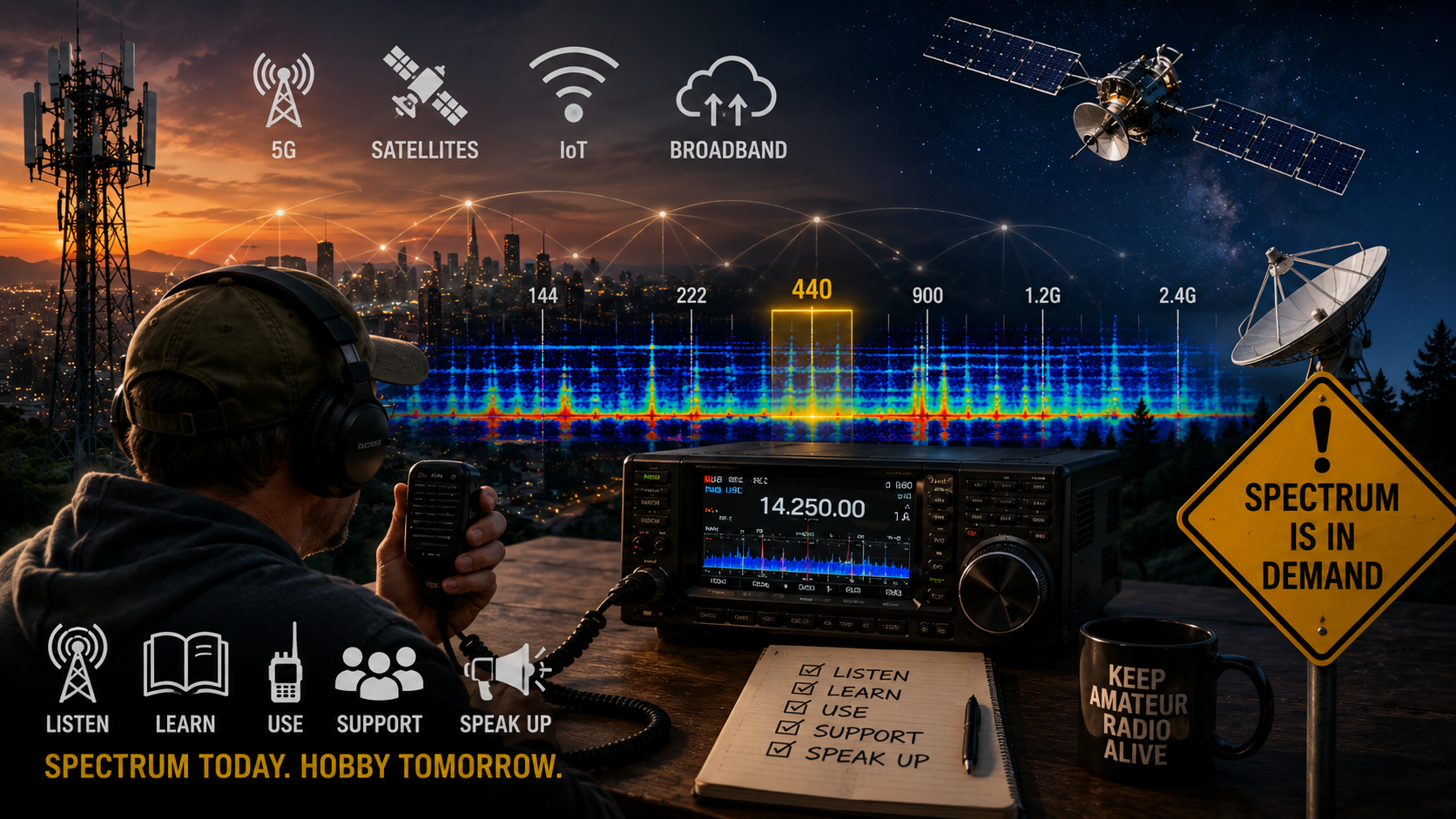
I don’t spend a lot of time worrying that someone is going to show up tomorrow and take away 20 meters.
I don’t think we’re going to wake up on Monday morning, turn on the radio, and discover that 14.250 is now being used to download Netflix to someone’s refrigerator.
But I do think amateur radio operators need to pay more attention to spectrum.
Because our bands have value.
A lot of value.
Commercial communications are growing.
Satellite systems are growing.
Wireless technology is expanding.
Everyone wants more spectrum.
And we’re sitting on allocations that sometimes sound pretty quiet.
That should probably get our attention.
Want More Portable Radio Content?
Practical portable operating, POTA discussions, gear reviews, Brew & Activate livestreams, and real-world ham radio content.
Spectrum Is Real Estate
The easiest way I can explain spectrum is to think of it like real estate.
There is only so much desirable property.
Some locations are more valuable than others.
Some have better access.
Some have better terrain.
And everyone wants the good stuff.
Radio spectrum works the same way.
Different frequencies have different characteristics.
Some travel long distances.
Some penetrate buildings better.
Some support wider bandwidth.
Some work well for satellites.
Some are incredibly valuable for commercial communications.
Companies spend enormous amounts of money to gain access to spectrum.
Governments carefully manage it.
Engineers spend years figuring out how multiple services can share it.
And then there’s amateur radio.
We have access to a remarkable collection of frequencies.
HF.
VHF.
UHF.
Microwave.
That access exists for a reason.
But I think sometimes we act like it is permanent simply because it has always been there.
History tells us that is not necessarily true.
Keep the Conversation Going
What’s one thing you stopped bringing to activations because you realized you never actually needed it? Drop into the Discord and tell the Brew Crew.
Join the N1JUR DiscordLook at the 70-Centimeter Conversation
The recent discussion around 430–440 MHz should have gotten the attention of amateur radio operators.
AST SpaceMobile requested access connected to telemetry, tracking, and control for its satellite constellation.
In April 2026, the FCC granted limited authorization for emergency use of five 50-kHz channels within 430–440 MHz when those satellites are outside the United States.
Limited.
Emergency use.
Outside the United States.
Those details matter.
This is not the same thing as a company being handed the entire 70-centimeter band.
We need to be accurate when we talk about these issues.
But we should also pay attention.
Because the request involved spectrum used by amateur radio operators around the world.
Satellites.
Weak signal.
Digital communications.
Television.
Repeaters.
Experimentation.
The FCC proceeding received more than 2,500 comments from amateur radio organizations and individual operators.
People noticed.
Organizations responded.
Technical concerns were raised.
That’s how spectrum awareness is supposed to work.
Not panic.
Participation.
This Isn’t the First Spectrum Conversation
Amateur radio has been through these discussions before.
And it will happen again.
The 902–928 MHz band has been the subject of spectrum-protection efforts.
The 23-centimeter band has required international work around coexistence with radio-navigation satellite services.
Higher-frequency amateur allocations exist in areas where commercial, satellite, navigation, and government systems also have significant interests.
Some amateur allocations are primary.
Others are secondary.
That distinction matters.
A secondary allocation does not mean:
“Here’s your frequency forever. Do whatever you want.”
It means amateur radio may have to coexist with other services and accept certain limitations.
This is why organizations like ARRL and the International Amateur Radio Union spend time on spectrum defense.
Someone has to be in the room.
Someone has to review the technical studies.
Someone has to file comments.
Someone has to explain how amateur spectrum is actually being used.
Because if we’re not part of the conversation, we shouldn’t be surprised when the conversation happens without us.
Warning Sign #1: We Don’t Know What’s Happening
This might be the biggest warning sign.
Most hams have no idea when a spectrum issue is being discussed.
I understand why.
FCC proceedings are not exactly exciting reading.
Nobody is sitting at breakfast thinking:
“You know what would go great with this coffee? A 96-page regulatory filing.”
But we should at least know when an issue affects amateur spectrum.
Follow reliable amateur-radio news.
Read regulatory updates.
Pay attention when ARRL, AMSAT, or IARU raises a spectrum concern.
Then go look at the actual issue.
Not the Facebook headline.
Not the YouTube thumbnail that says:
THE FCC IS TAKING 70CM TOMORROW!!!
The actual issue.
What frequencies?
What type of authorization?
Primary or secondary allocation?
Temporary or permanent?
Domestic or international?
What are the technical concerns?
Awareness starts with understanding what is actually happening.
Warning Sign #2: We Only Care After a Decision Is Made
Amateur radio is really good at reacting.
A decision happens.
Someone posts about it.
Everyone gets angry.
The forums explode.
People write 4,000-word Facebook comments.
Three weeks later, everyone moves on to arguing about FT8.
Spectrum issues often develop over months or years.
There are proposals.
Comment periods.
Technical studies.
Replies.
International meetings.
Regulatory decisions.
If the first time we hear about an issue is after the final decision, we’re late.
Like What’s Happening Here?
N1JUR is built around helping more people get active in ham radio through videos, Field Notes, POTA content, live streams, gear reviews, and community.
If you already watch the channel and want to support more of the work behind it, memberships are one way to help keep the signal going.
Videos. Field Notes. Live Streams. Community.
Membership support helps keep the N1JUR ecosystem moving without turning every page into a pledge drive wearing a callsign hat.
Learn About the Community →Pay attention earlier.
When a legitimate organization says:
“This proceeding could affect amateur spectrum.”
That’s the time to read.
That’s the time to learn.
And if public comments are appropriate, that’s the time to participate.
Warning Sign #3: We Can’t Explain How We Use the Band
This is the uncomfortable one.
Imagine someone asks:
“What do amateur radio operators actually do with this spectrum?”
Can we answer?
Not:
“We’ve always had it.”
Not:
“Ham radio is important during emergencies.”
Specifically.
What happens there?
Repeaters.
Satellite communications.
Weak-signal experimentation.
Digital systems.
Propagation research.
Amateur television.
Earth-Moon-Earth communication.
Beacons.
Technical experimentation.
Education.
We need to be able to explain the value of amateur spectrum in practical terms.
And here’s the harder question.
Are we actually doing those things?
A band plan printed on a wall does not demonstrate spectrum use.
Operators do.
Warning Sign #4: Entire Parts of Our Allocations Stay Invisible
Quiet spectrum is not automatically unused spectrum.
That’s important.
Weak-signal activity might not be heard on an FM radio.
Satellite operations happen during specific passes.
Microwave activity can be highly directional.
Digital signals may occupy relatively small areas of a band.
Technical experimentation does not always create a 24-hour wall of RF.
Spectrum occupancy is complicated.
But perception matters.
If amateur radio cannot document, explain, and demonstrate how bands are used, other interests may look at those frequencies and see opportunity.
We need better awareness of activity outside our own corner of the hobby.
The repeater operator should understand that weak-signal operators exist.
HF operators should know what happens in the microwave bands.
Portable operators should understand amateur satellites.
We don’t all have to participate in everything.
But we should understand the hobby we’re trying to protect.
Warning Sign #5: We Treat Spectrum Defense Like Someone Else’s Job
This is probably the easiest trap.
ARRL will handle it.
AMSAT will handle it.
IARU will handle it.
Someone who understands regulatory stuff will handle it.
And yes.
We absolutely need organizations with technical and regulatory expertise representing amateur radio.
I do not want 700,000 individual hams independently negotiating international spectrum policy.
That sounds terrible.
But those organizations need support.
They need members.
They need technical contributors.
They need operators documenting interference.
They need people paying attention.
And when a public proceeding legitimately affects amateur radio, they need informed operators participating appropriately.
Spectrum defense is a team effort.
Some people write technical studies.
Some file regulatory comments.
Some support the organizations doing that work.
And some simply make sure accurate information reaches other operators.
All of that matters.
Don’t Panic. Pay Attention.
I want to make this very clear.
I do not think amateur radio operators should panic every time a company files something with the FCC.
Not every spectrum-sharing proposal is an attack on ham radio.
Not every commercial satellite is coming for our bands.
Not every regulatory change means the hobby is ending.
Spectrum sharing is complicated.
Technology changes.
New systems need frequencies.
Existing services need protection.
There will always be negotiation.
Our job is to pay attention.
Ask good questions.
Understand the technical issue.
And make sure amateur radio has a voice in the process.
Fear doesn’t protect spectrum.
Technical facts do.
Participation does.
Awareness does.
Use the Bands
There is another part of this conversation that I think is much simpler.
Use the spectrum we have.
Try 10 meters.
Get on 6 meters.
Experiment with 2-meter SSB.
Work satellites.
Explore 70 centimeters beyond the local repeater.
Look into 900 MHz.
Try weak signal.
Build an antenna.
Learn what happens above UHF.
I’m guilty of staying in my comfortable parts of amateur radio too.
HF.
POTA.
VHF and UHF FM.
Satellites.
There is an enormous amount of amateur spectrum I barely touch.
Maybe that’s something we should all think about.
We spend a lot of time buying radios that cover more frequencies.
Then we use the same five frequencies.
Use the bands.
Experiment.
Document what you’re doing.
Share it.
Teach someone else.
Visible activity helps demonstrate that amateur spectrum supports an active technical service.
Report Real Interference
If you experience legitimate interference, document it.
Frequency.
Time.
Location.
Mode.
Duration.
What you observed.
Recordings or spectrum captures when appropriate.
Don’t immediately post:
“THE GOVERNMENT IS JAMMING MY BAOFENG.”
Collect information.
Talk to experienced operators.
Determine whether the problem is actually interference.
Your LED lights might be the enemy.
So might the phone charger you bought for $4 at a gas station.
But when interference is legitimate, accurate reports matter.
Good data is useful.
Rumors are not.
Teach New Hams That Bands Are More Than Frequencies
We also need to do a better job explaining spectrum to new operators.
The band chart should not just be a collection of places they’re allowed to transmit.
Each band has history.
Characteristics.
Operating activities.
Technical opportunities.
Limitations.
Teach someone why 6 meters is called the Magic Band.
Show them satellite activity on 70 centimeters.
Demonstrate 2-meter SSB.
Explain secondary allocations.
Talk about band plans.
When operators understand spectrum, they are more likely to care about protecting it.
You protect things you understand.
Support the People Doing the Boring Work
I’m going to say something that probably won’t make a great YouTube thumbnail.
Regulatory work matters.
It’s boring.
There.
I said it.
Technical filings matter.
Spectrum studies matter.
International coordination matters.
FCC comments matter.
Band planning matters.
Nobody is making dramatic slow-motion B-roll of someone reading an ITU document.
But this work helps protect the frequencies where the rest of us get to play radio.
Pay attention to organizations doing legitimate spectrum work.
ARRL.
AMSAT.
IARU.
Other technical and amateur-radio organizations.
You do not have to agree with every decision these organizations make.
That’s a completely different conversation.
But spectrum representation requires expertise, time, and money.
Someone has to do the boring work.
The Biggest Warning Sign Is Apathy
Commercial communications will continue growing.
Satellite constellations will continue growing.
Wireless technology will continue growing.
The value of spectrum is not going down.
Amateur radio exists in that environment.
Our bands are not protected by nostalgia.
They’re protected through regulation, international agreements, technical advocacy, and a demonstrated purpose for the Amateur Radio Service.
That’s why apathy concerns me more than any single spectrum proposal.
If we stop paying attention…
If we stop experimenting…
If we stop using the bands…
If we can’t explain why amateur spectrum matters…
Then we make the argument for our future much harder.
Keep the Hobby Worth Protecting
Are amateur radio bands under pressure?
Some allocations clearly face more complicated sharing and regulatory questions than others.
And I think those conversations will continue.
But I don’t want hams operating in fear.
I want us operating with awareness.
Read.
Learn.
Experiment.
Use the bands.
Support spectrum advocacy.
Document legitimate problems.
Teach new operators why these frequencies matter.
And most importantly, keep amateur radio active.
The best argument for the future of amateur radio is a hobby that is still experimenting, still educating, still communicating, and still finding new things to do with RF.
We have an incredible amount of spectrum available to us.
Let’s understand it.
Let’s use it.
And let’s make sure the next generation gets the same opportunity to go play radio.