
The Xiegu G7250: Staying Level-Headed While Everyone Else Chases the Hype
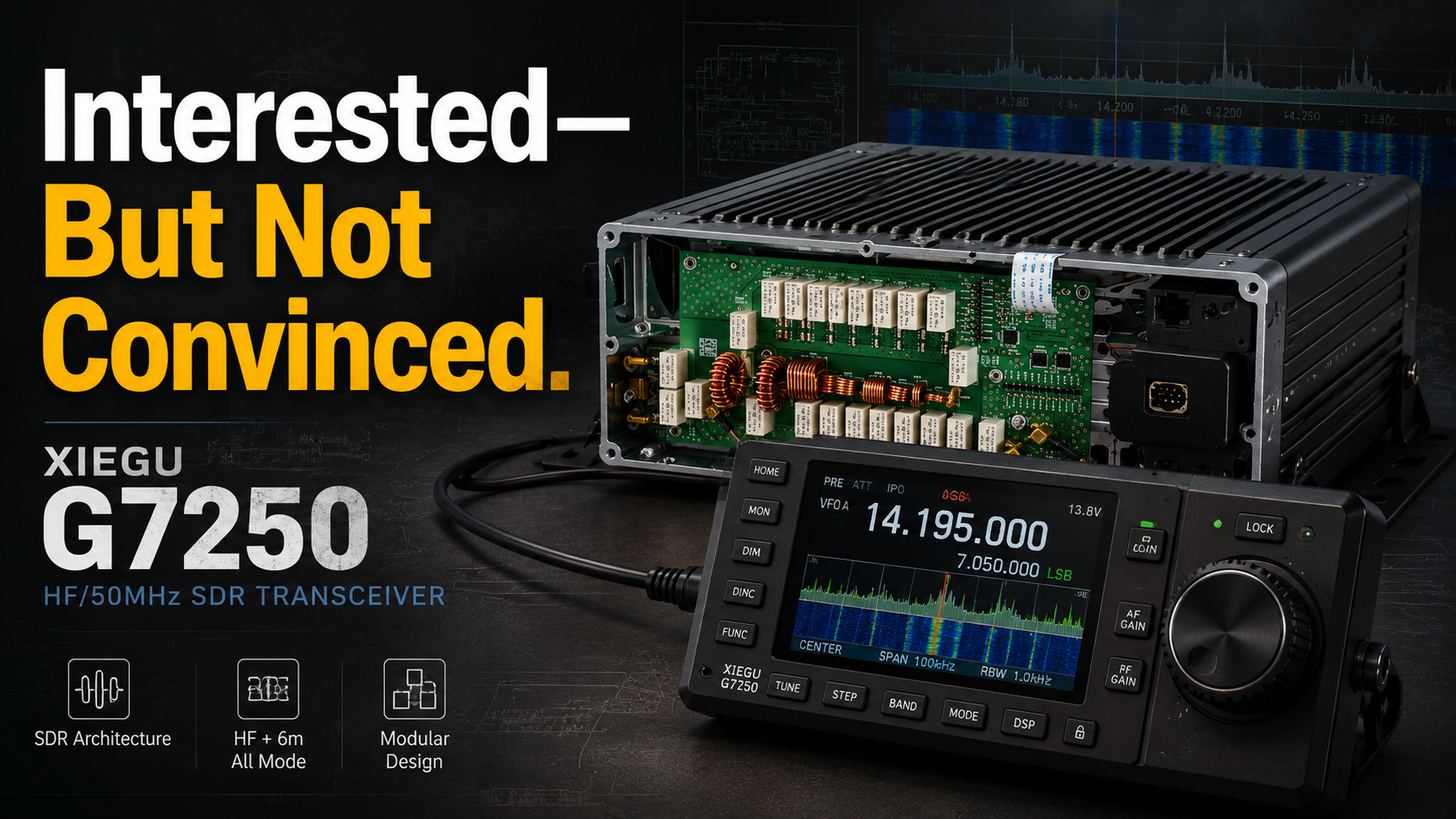
Every time a new radio appears, amateur radio seems to go through the same cycle.
A few product photos get released. A preliminary specification page appears. Somebody notices a large display, an Ethernet connection, or a feature that looks different from what the established manufacturers are offering.
Within hours, the radio is either being called a game changer or written off as another unfinished product.
The new Xiegu G7250 is already entering that cycle.
At first glance, there is plenty to be interested in. It is a 100-watt HF and 6-meter direct-sampling SDR with a large detachable control head, an internal antenna tuner, network connectivity, and a modern-looking interface.
That is enough to get people talking.
It is not enough to tell us whether the radio is actually good.
Want More Portable Radio Content?
Practical portable operating, POTA discussions, gear reviews, Brew & Activate livestreams, and real-world ham radio content.
This Is Not a Review
Let us begin with the most important point.
I have not operated the Xiegu G7250.
Very few people have, and the information currently available is based on a prototype. Radioddity has specifically stated that the published features and performance figures may change before the final product is released.
That means this is not a review, a recommendation, or a declaration that the G7250 will succeed or fail.
It is an attempt to look at the information we currently have without getting pulled into the launch-day excitement.
There are three categories we need to keep separate:
What has been confirmed
What the specifications reasonably suggest
What remains unknown
Unfortunately, those lines tend to become blurred whenever a new radio is announced.
The G7250 Specification Sheet Looks Familiar
One of the more interesting things about the G7250 is how closely some of its published numbers resemble existing Xiegu products.
The G7250 currently lists receiver sensitivity of 0.2 microvolts for SSB and CW, a minimum discernible signal of minus 138 dBm, one-hertz tuning steps, and a 300-to-2700-hertz SSB transmit response.
Those figures are remarkably similar to the specifications published for the Xiegu X6200.
That does not prove that the G7250 is simply an X6200 in a larger enclosure. We would need a teardown, schematic, detailed block diagram, or confirmation from Xiegu before making that claim.
It does, however, raise a reasonable question.
Is the G7250 built around a completely new receiver platform, or is it an evolution of Xiegu’s existing direct-sampling SDR and DSP architecture?
There would be nothing inherently wrong with the second possibility.
Manufacturers reuse and improve platforms all the time. A well-understood receiver design placed into a better-integrated 100-watt radio could be a very practical product.
But it would mean the real innovation may be the packaging, networking, control head, and user experience rather than a revolutionary new receiver.
That distinction matters.
Keep the Conversation Going
What’s one thing you stopped bringing to activations because you realized you never actually needed it? Drop into the Discord and tell the Brew Crew.
Join the N1JUR DiscordSensitivity Does Not Tell the Whole Receiver Story
The current product information emphasizes receiver sensitivity and describes a two-stage, large-dynamic-range preamplifier with “outstanding IP3 performance.”
The problem is that no actual IP3 measurement is provided.
We also do not currently have published figures for:
Reciprocal mixing dynamic range
Blocking dynamic range
Third-order dynamic range
ADC resolution
ADC sample rate
Phase noise
ADC overload level
Close-spacing performance
Measurement bandwidth
Preamp and attenuator conditions
This is where product-page excitement can become misleading.
Sensitivity tells us how well a radio may detect a weak signal under relatively quiet conditions. It does not tell us how the receiver behaves when a strong signal appears nearby.
That difference becomes obvious during Field Day, a contest, a busy weekend activation, or any situation where a weak station is surrounded by much stronger signals.
A receiver can sound impressive on an empty band and still struggle badly when the band becomes crowded.
That is why manufacturers such as Yaesu and FlexRadio publish close-spacing receiver measurements. Those numbers give operators something meaningful to compare.
“Outstanding IP3” may eventually prove to be accurate.
For now, it is an adjective without a measurement.
The Sensitivity Numbers Need Context
There is another detail worth examining.
A 0.2-microvolt signal into a 50-ohm receiver is approximately minus 121 dBm.
The published minimum discernible signal is minus 138 dBm.
That is roughly a 17-decibel difference.
This does not necessarily mean either figure is wrong.
The two numbers may have been measured using different filter widths, preamplifier settings, modes, frequencies, or signal-to-noise criteria.
The problem is that those test conditions have not been clearly stated on the preliminary G7250 page.
Without measurement conditions, a specification becomes difficult to compare with another radio.
It may still be useful as a general indication, but it is not a complete engineering benchmark.
This is an area where the final manual or test documentation needs to provide more clarity.
Like What’s Happening Here?
N1JUR is built around helping more people get active in ham radio through videos, Field Notes, POTA content, live streams, gear reviews, and community.
If you already watch the channel and want to support more of the work behind it, memberships are one way to help keep the signal going.
Videos. Field Notes. Live Streams. Community.
Membership support helps keep the N1JUR ecosystem moving without turning every page into a pledge drive wearing a callsign hat.
Learn About the Community →Is This an Existing Xiegu Platform Brought Together?
The transmitter side of the specification sheet also looks familiar.
The G7250 is currently rated for 100 watts on HF, 90 watts on 6 meters, and a maximum current draw of 25 amps.
Xiegu’s GPA100 amplifier is also rated for 100 watts on HF with a maximum current draw of 25 amps. The six-meter specification is not identical, so this is not a one-to-one match.
Still, it creates another reasonable theory.
The G7250 may combine:
An evolved X6200-style receiver and DSP platform
A revised version of Xiegu’s 100-watt amplifier technology
A relay-switched internal tuner
A new seven-inch control head
Network-based communication between the head and radio body
Again, that is only a theory.
But it is a more grounded theory than declaring the radio revolutionary based on a few product photographs.
And honestly, that combination could make a great radio.
Xiegu does not necessarily need to reinvent every circuit. It needs to make the pieces work together reliably, cleanly, and consistently.
The challenge will be integration and execution.
One Hundred Watts May Not Always Mean One Hundred Watts
The G7250’s preliminary output specification is listed as 100 watts, plus or minus one decibel.
That tolerance is wider than it may first appear.
Mathematically, one decibel below 100 watts is roughly 79 watts, while one decibel above 100 watts is approximately 126 watts.
That does not mean production radios will necessarily vary across that entire range.
It does mean the published specification does not guarantee exactly 100 watts under every condition.
There are also several questions that the current product page does not answer:
Does the radio maintain full output at 12 volts?
What does it produce from a 12.8-volt battery?
Is full output only available near 13.8 or 15 volts?
What happens as supply voltage drops?
Does the radio reduce output during extended FT8 or RTTY operation?
How does the amplifier manage heat?
How noisy is the cooling system?
What is the recommended digital-mode duty cycle?
The radio may operate from nine to 15 volts, but that does not mean it produces 100 watts throughout that entire range.
That will require real testing.
Ethernet Does Not Automatically Mean Internet Remote Operation
The detachable control head is probably the most interesting feature of the G7250.
Radioddity says the head can be separated from the RF deck by as much as 100 meters using Ethernet cable. The radio is also said to provide receive-side baseband streaming to compatible SDR software.
That could create some very useful installation options.
The RF deck could potentially be placed closer to the antenna feed point. It could be mounted out of the way in a vehicle, go box, operating trailer, or remote section of the shack.
The large display and controls could remain at the operating position.
But an Ethernet connector does not automatically make a radio network-native.
We do not yet know whether the G7250 supports:
Normal operation through an Ethernet switch
A standard IP address
Routed-network operation
Internet remote operation
Remote transmit audio
CAT control over the network
Remote PTT
Remote CW keying
Multiple network clients
Standard Power over Ethernet
Operation through a VPN
It is entirely possible that the control head uses Ethernet hardware and cable for a proprietary point-to-point connection.
That would still be useful.
It would simply be different from the complete network and Internet remote systems available from FlexRadio or the newer Icom platforms.
The wording on the product page is also important.
It specifically mentions receive-side baseband streaming.
That may provide an external waterfall or IQ data without offering complete transmit and radio-control functionality.
Until the networking documentation is published, the fairest description is that the G7250 has a remotely connected control head and receive-side baseband streaming.
Anything beyond that remains unconfirmed.
The Internal Tuner Appears Fairly Conventional
The G7250’s internal tuner is currently listed with an impedance-matching range of 20 to 150 ohms.
For a purely resistive load, that works out to approximately a 2.5-to-1 SWR at the low end and a 3-to-1 SWR at the high end.
That is a normal internal-radio tuner range.
It should be useful for adjusting an antenna that is already reasonably close to resonance.
It is not a wide-range tuner designed to make nearly any random wire work.
The product page also promotes very fast tuning. However, the published details indicate that a new tuning solution may take as long as 10 seconds, while a previously stored solution can be recalled in less than one-tenth of a second.
Those are two different operations.
A fast memory recall is helpful, but it does not mean the tuner is finding a new match in a fraction of a second.
There are still unanswered questions about the tuner:
How many memories are available?
Are they stored by band or by specific frequency?
How wide is the frequency window for each memory?
What reactive loads can it match?
How much power is used during the tuning cycle?
Does the radio automatically reduce power while tuning?
Calling it heavy-duty or lightning-fast does not answer those questions.
The Transmitter May Be the Area That Deserves the Most Attention
Most of the launch discussion has focused on the screen, receiver, tuner, and remote head.
The transmitter specifications may ultimately be more important.
The preliminary G7250 information lists at least 55 dB of spurious suppression, at least 40 dB of carrier suppression, and at least 50 dB of unwanted-sideband suppression.
The listed carrier-suppression requirement is weaker on paper than the figure published for the X6200.
That could be caused by several things:
A conservative prototype specification
A documentation error
An unfinished transmitter design
A copied figure from an older platform
A genuine limitation
There is currently no way to know which explanation is correct.
This is why real transmitter testing matters.
I want to see:
Two-tone SSB testing
Third- and fifth-order IMD measurements
Carrier leakage
Opposite-sideband suppression
Harmonic and spurious output
Transmit phase noise
Performance at reduced and full power
Six-meter spectral purity
Performance after the amplifier becomes warm
A radio can sound acceptable during an on-air demonstration while still producing a signal that is unnecessarily wide or dirty.
A large waterfall cannot compensate for poor transmitted RF.
We Should Not Assume Features That Have Not Been Announced
The G7250 is an SDR with a large touchscreen, which can lead people to assume it has features that have not actually been confirmed.
We should not yet assume that it includes:
Two independent receivers
Full-duplex operation
Diversity reception
A built-in USB sound card
CAT and audio through one USB connection
External-monitor support
Multiple receive antenna inputs
Full third-party SDR control
Complete Internet remote operation
The absence of these features from the current page does not prove that the production radio will lack them.
It simply means they have not been confirmed.
That may sound like a minor distinction, but it is at the center of nearly every premature launch video.
“Not listed” does not always mean “not included.”
It also does not mean we should assume it is there.
What Could Make the G7250 Genuinely Different?
Despite all these unanswered questions, I think the G7250 has real potential.
The detachable seven-inch control head could give it an installation advantage over traditional radios with fixed front panels.
That feature could make sense in:
A home station with the RF deck placed away from the operator
A vehicle installation with limited dashboard space
A go box or portable station
A trailer or emergency-communications setup
A station where the radio body is placed near the antenna entry point
A remote operating position inside the same building or property
If Xiegu eventually supports full routed-network operation, transmit audio, remote PTT, CAT control, and documented network protocols, the platform could become significantly more capable.
That remains a large “if.”
At the moment, the control-head architecture is the clearest differentiator.
The receiver specifications do not yet establish it as an FT-710-class performer.
The network connection does not yet establish it as a FlexRadio-style remote system.
The tuner does not appear to be wider than the standard internal tuners found in many desktop radios.
The screen is attractive, but the G7250 will succeed or fail based on what happens behind that screen.
The Questions That Matter More Than the Product Photos
Before the G7250 can be meaningfully compared with established 100-watt SDR transceivers, several questions need answers.
Receiver Performance
What ADC is being used?
What is its resolution and sampling rate?
What are the reciprocal mixing, blocking, and third-order dynamic-range figures?
How does the receiver behave with strong signals two or five kilohertz away?
Where does the ADC overload?
Transmitter Performance
How clean is the SSB signal at 100 watts?
How does it perform on six meters?
What happens during extended digital-mode transmissions?
Does output decrease as temperature rises?
How effective are the low-pass filters?
Network Operation
Can the control head work through a normal network switch?
Can it cross a routed network?
Can it operate through a VPN?
Does the network carry transmit audio, PTT, CAT, and CW?
Does the control head require separate power?
Digital-Mode Integration
Does the radio include a built-in USB audio interface?
Can one USB cable handle CAT and audio?
Are standard drivers used?
What software is officially supported?
Firmware and Long-Term Support
How often will firmware be updated?
Can a failed update be recovered easily?
Will CAT commands and network protocols be documented?
Will announced features be fully functional at launch?
Those questions are not negative.
They are the normal questions we should ask about any modern SDR transceiver.
Curiosity Without the Hype
I am interested in the Xiegu G7250.
A 100-watt HF and 6-meter SDR with a large detachable control head could fill a useful space between compact portable radios and traditional desktop transceivers.
It could offer installation flexibility that the established manufacturers are not currently emphasizing.
It could also turn out to be a very clever combination of technologies Xiegu already understands.
Neither possibility makes the radio good or bad.
That judgment will come from the final hardware, firmware, documentation, and testing.
The current prototype page gives us enough information to become curious.
It does not give us enough information to declare the G7250 a game changer, an IC-7300 killer, or a disappointment.
The amateur-radio community would benefit from becoming more comfortable with that middle ground.
We can be interested without being sold.
We can identify promising ideas without pretending they are proven.
We can question incomplete specifications without assuming the worst.
Most importantly, we can wait for evidence.
The final story of the Xiegu G7250 will not be told by promotional images, screen size, or launch-day excitement.
It will be told by receiver measurements, transmitter cleanliness, thermal performance, firmware stability, network documentation, and operators using the radio under difficult real-world conditions.
Until then, I am not buying the hype.
I am also not dismissing the radio.
I am simply waiting for it to prove what it can do.