
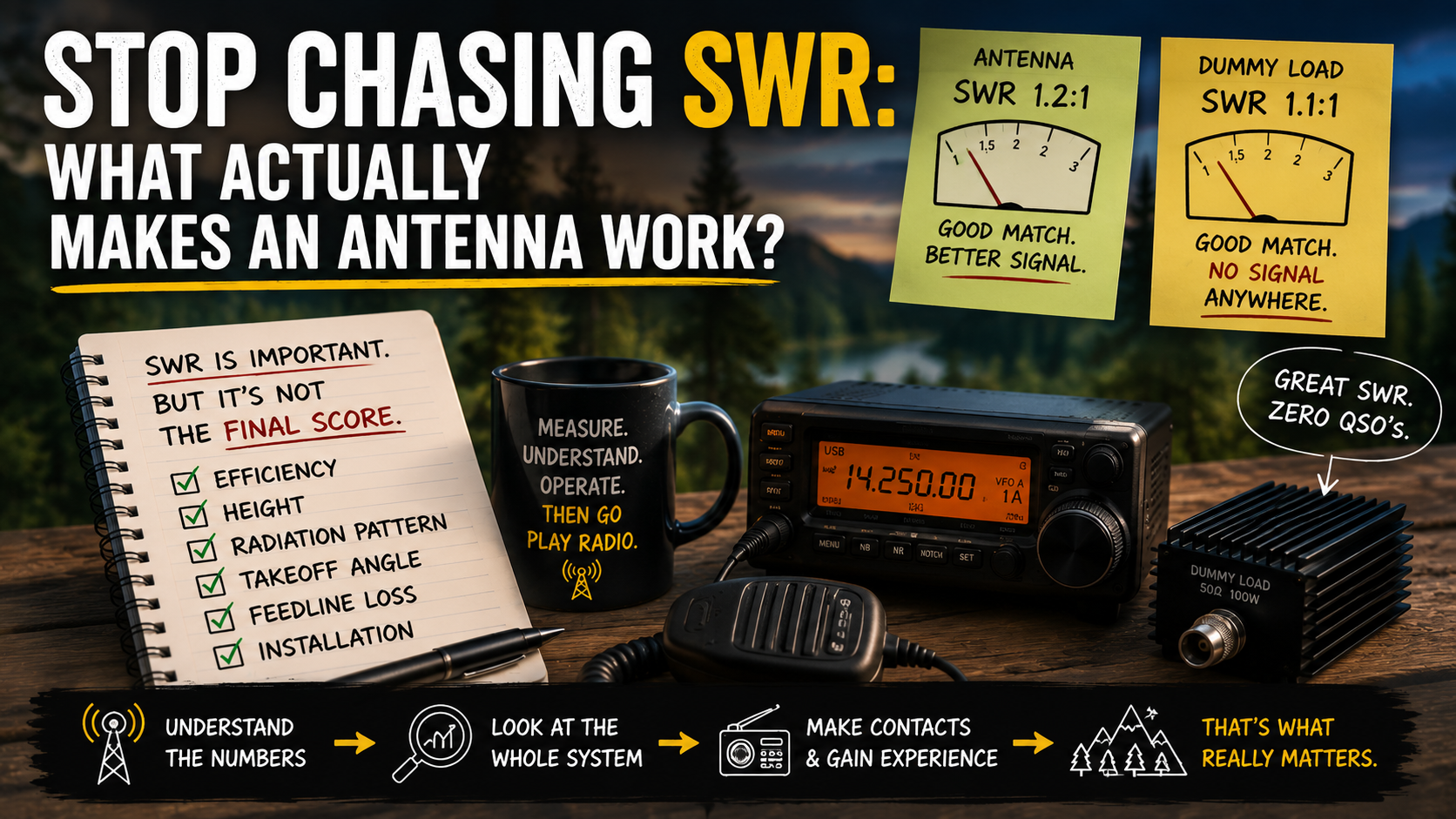
Stop Chasing SWR: What Actually Makes an Antenna Work?
I’ve apparently spent a lot of time talking about antennas lately.
SWR.
Resonance.
Reactance.
Coax.
Efficiency.
At some point during Brew & Activate, we crossed the line from talking about portable radio into what I can only describe as antenna group therapy.
And I’ve noticed something.
We are obsessed with SWR.
I mean really obsessed.
Someone sets up an antenna at a park.
They connect the analyzer.
1.7:1.
And immediately…
Something must be wrong.
Move the antenna.
Adjust the whip.
Change the counterpoise.
Move the coil.
Check it again.
1.4:1.
Getting closer.
Another adjustment.
1.2:1.
Now we’re happy.
Meanwhile, someone 500 miles away has been calling you for the last ten minutes and you haven’t actually turned the radio on yet.
Maybe it’s time we stop chasing SWR.
Because a low SWR doesn’t automatically mean you have a good antenna.
Keep the Conversation Going
What’s one thing you stopped bringing to activations because you realized you never actually needed it? Drop into the Discord and tell the Brew Crew.
Join the N1JUR DiscordSWR Is a Number We Understand
I think the reason we obsess over SWR is pretty simple.
It’s easy.
One is good.
Three is bad.
Right?
That’s basically how most of us were introduced to SWR.
Get the antenna as close to 1:1 as possible and everything will be wonderful.
The clouds will separate.
The RF gods will smile.
DX stations will immediately begin fighting over who gets to work you first.
Unfortunately, antennas don’t work that way.
SWR tells us about the match between the antenna system and the feedline.
That’s useful information.
Very useful information.
But it doesn’t tell us everything about how well the antenna is radiating.
We spent an entire Brew & Activate episode digging into this because SWR might be one of the most misunderstood numbers in amateur radio.
If you want the deeper discussion, check out Getting Nerdy About Antennas: SWR, Resonance & Reactance — Part 1 on Brew & Activate.
But the short version is this:
Your radio can be very happy with the antenna system.
That doesn’t necessarily mean your signal is going where you want it to go.
A Dummy Load Has Great SWR
This is the example I keep coming back to.
Connect a good dummy load to your radio.
Check the SWR.
Beautiful.
Close to 1:1.
Your radio is thrilled.
Now call CQ.
Want More Portable Radio Content?
Practical portable operating, POTA discussions, gear reviews, Brew & Activate livestreams, and real-world ham radio content.
Let me know how the pileup goes.
The dummy load is doing exactly what it was designed to do.
It’s absorbing RF energy and converting it into heat.
It presents a nice load to the transmitter.
But we’re not trying to heat a resistor.
We’re trying to radiate RF.
That’s the difference between a good match and a good antenna.
A low SWR tells you the radio sees an acceptable load.
It doesn’t tell you how much of that energy becomes useful radiation.
Then We Started Talking About Resonance
This is where the antenna conversation gets more interesting.
After the SWR episode, we moved into resonance.
And this is another area where I think hams sometimes combine two different ideas.
Low SWR.
Resonance.
They aren’t the same thing.
An antenna can be resonant and still not show a perfect 1:1 SWR.
We talked about this in Most Hams Get Resonance Wrong — Do You?
One of the examples we used was an antenna showing something around 25 ohms of resistance with essentially zero reactance.
The antenna is resonant.
The reactive component is gone.
But we’re feeding it with a 50-ohm system.
The result?
About a 2:1 SWR.
If you’re only watching the SWR number, you might start cutting the antenna.
But the antenna is already resonant.
You don’t necessarily have a resonance problem.
You have an impedance matching problem.
That’s a very different problem.
And it requires a very different solution.
Your Analyzer Is Trying to Tell You More
This is why I think antenna analyzers are incredible tools.
But only if we stop using them as expensive SWR meters.
Look at the screen.
Really look at it.
Resistance.
Reactance.
Impedance.
Frequency.
SWR.
Those numbers are telling you a story.
If the reactance is close to zero, you’re near resonance.
If the resistance isn’t close to 50 ohms, you may have a matching issue.
If everything changes dramatically when you move the coax, touch the radio, or walk around the antenna…
Well.
Now we’ve got another conversation.
Maybe common-mode current.
Maybe the feedline is becoming part of the antenna system.
Maybe the installation is interacting with the antenna.
The analyzer isn’t just giving you a grade.
It’s giving you clues.
Stop asking:
“How do I get this to 1:1?”
Start asking:
“Why am I seeing these numbers?”
That’s when antenna tuning becomes experimentation instead of knob turning.
So What Actually Makes an Antenna Work?
This was really the question behind our third antenna discussion on Brew & Activate.
Your SWR Is Fine… So Why Can’t You Make Contacts?
Because once the SWR is reasonable, there are a lot of other things that affect your signal.
Efficiency.
Radiation pattern.
Takeoff angle.
Height above ground.
Ground losses.
Loading coils.
Feedline loss.
Installation.
Terrain.
Propagation.
You can have a beautiful SWR and still have an antenna system that isn’t performing the way you expect.
Let’s take a portable vertical.
You tune it.
1.1:1.
Perfect.
But you have a heavily loaded antenna with a tiny coil, a short whip, and a poor radial system.
The radio sees a good match.
That doesn’t magically eliminate the losses in the system.
Some of your RF might be radiating.
Some might be heating the coil.
Some might be lost in the ground system.
The SWR meter doesn’t separate those for you.
It just tells you the radio likes the load.
Efficiency Isn’t Nearly as Exciting as SWR
This might be why we don’t talk about efficiency as much.
It’s harder to see.
I can show you an SWR meter.
Look.
1.2:1.
Everyone understands that.
Efficiency is different.
You have to think about where the energy is going.
Let’s say you’re transmitting 100 watts.
The radio says 100 watts.
The SWR looks great.
But the antenna system is inefficient.
Maybe only part of that energy becomes useful RF.
The rest becomes heat or is lost somewhere in the system.
Now compare that to a more efficient antenna with a 1.7:1 SWR.
Which antenna would you rather use?
I’ll take the antenna that puts more RF into the air.
The other station can’t see your SWR meter.
They only hear your signal.
Height Changes Everything
Portable operators learn this one quickly.
You can tune an antenna perfectly at home.
Take it to the park.
Deploy it.
And the numbers change.
Why?
The antenna didn’t read the instruction manual.
Trees.
Ground conductivity.
Height.
Nearby structures.
Your vehicle.
Even how you route the coax can affect the system.
Height also changes the radiation pattern.
A horizontal antenna close to the ground may send a lot of energy at higher angles.
Raise it and the pattern begins to change.
That might be great.
It might not.
It depends on what you’re trying to do.
If I’m activating a park and want regional contacts, one antenna configuration might work incredibly well.
If I’m chasing DX, I might want something completely different.
Again…
What are you trying to accomplish?
That’s the question.
Not:
“What’s the SWR?”
Radiation Pattern Matters
This is another thing the SWR meter can’t tell you.
Where is your signal going?
An antenna doesn’t necessarily radiate equally in every direction.
Dipoles have patterns.
Verticals have patterns.
Yagis definitely have patterns.
Even portable antenna installations can change the pattern based on the environment.
You could have a 1:1 SWR and a giant null pointed directly at the station you’re trying to work.
The antenna isn’t broken.
Physics is just being physics.
This is why antenna orientation matters.
It’s why height matters.
It’s why satellite operators point antennas.
It’s why VHF weak-signal operators care about direction.
And it’s why sometimes moving or rotating an antenna can make a bigger difference than another hour of tuning.
The Antenna Is a System
This is probably the biggest lesson from our entire Brew & Activate antenna series.
Stop thinking about the antenna as one piece of wire.
The antenna is a system.
Radio.
Feedline.
Connectors.
Matching network.
Transformer.
Coil.
Radiating element.
Radials or counterpoise.
Ground.
Installation.
Environment.
All of those pieces interact.
Change one thing and something else might change.
This is especially obvious with portable antennas because we rebuild the station every time we go outside.
At home, your antenna installation stays relatively consistent.
At a park?
New ground.
New trees.
New height.
New coax routing.
New terrain.
Sometimes a picnic table that appears to have been constructed entirely from RF-absorbing government technology.
Every activation is a new antenna installation.
That’s why portable radio is such a good classroom.
Stop Tuning When the Antenna Is Working
This might get me in trouble.
At some point…
Stop tuning.
If the SWR is within a safe range for your radio…
The antenna is behaving the way you expect…
And you’re making contacts…
Go play radio.
I have watched operators spend more time tuning an antenna than operating it.
I’ve done it too.
You get close.
1.5:1.
But you know you can do better.
So you make one more adjustment.
1.8:1.
Oops.
Go back.
1.3:1.
Now we’re really close.
One more adjustment.
And 45 minutes later, you’ve achieved 1.05:1.
Congratulations.
The band changed.
There is a point where the improvement on the meter doesn’t create a meaningful improvement on the air.
Learn when you’ve reached that point.
Use Contacts as Data
Here’s something I’ve started paying more attention to.
The log.
Where are you being heard?
Who can hear you?
What happens when you change antennas?
What happens when you change height?
What happens when you change bands?
Use tools like signal reports and propagation reporting networks when they’re available.
Compare activations.
Experiment.
If you always run the same antenna in the same configuration, you know it works.
But you don’t necessarily know why.
Change something.
Raise the antenna.
Lower it.
Change the orientation.
Try another radial configuration.
Reduce your power.
Then look at the results.
That’s amateur radio.
The analyzer gives you information before you transmit.
The contacts give you information after you transmit.
Use both.
SWR Still Matters
I want to be clear.
I’m not saying ignore SWR.
Please don’t email me a photo of your radio transmitting into a 12:1 SWR and say:
“Eric said SWR doesn’t matter.”
That’s not what I’m saying.
SWR is an important measurement.
It can help protect your equipment.
It can identify antenna problems.
It can show changes across a band.
It can help you understand the antenna system.
But SWR is one measurement.
It’s not the final score.
A 1:1 SWR doesn’t automatically mean the antenna is efficient.
It doesn’t tell you the radiation pattern.
It doesn’t tell you the takeoff angle.
It doesn’t tell you where your RF is going.
And it definitely doesn’t guarantee contacts.
Ask Better Questions
Maybe that’s the real point of this entire antenna rabbit hole we’ve gone down on Brew & Activate.
Stop asking:
“How do I get my SWR lower?”
Ask:
“Where is my antenna resonant?”
“What does the reactance look like?”
“What’s my feedpoint impedance?”
“Where are the losses?”
“What does the radiation pattern look like?”
“Is this antenna appropriate for what I’m trying to do?”
And the most important question:
“Am I making contacts?”
Like What’s Happening Here?
N1JUR is built around helping more people get active in ham radio through videos, Field Notes, POTA content, live streams, gear reviews, and community.
If you already watch the channel and want to support more of the work behind it, memberships are one way to help keep the signal going.
Videos. Field Notes. Live Streams. Community.
Membership support helps keep the N1JUR ecosystem moving without turning every page into a pledge drive wearing a callsign hat.
Learn About the Community →Because the person on the other end of the QSO doesn’t know if your SWR is 1.1 or 1.7.
They don’t know what analyzer you own.
They don’t know how many times you adjusted the whip.
They hear your signal.
That’s the test.
So use the analyzer.
Understand the numbers.
Build better antennas.
Experiment.
But at some point…
Put the analyzer back in the bag.
Connect the radio.
Call CQ.
And go play radio.