
Ham Radio Is Becoming an Outdoor Hobby — and That’s a Good Thing
I’ve been thinking about how much amateur radio has changed for me.
There was a time when “playing radio” meant walking into the shack.
Turn on the power supply.
Turn on the radio.
Check the bands.
Call CQ.
Maybe spin the dial for a while.
And there is absolutely nothing wrong with that.
I still love sitting in front of the IC-7300 and having a radio that is already connected to an antenna, already powered, and ready to go.
No deployment.
No battery math.
No wondering where I put the coax adapter that I definitely remember packing.
Just turn on the radio and play.
But lately, when I think about amateur radio, I find myself thinking about parks.
Mountains.
Picnic tables.
Parking lots.
Campgrounds.
And apparently random grid squares and map tiles that someone decided we should activate.
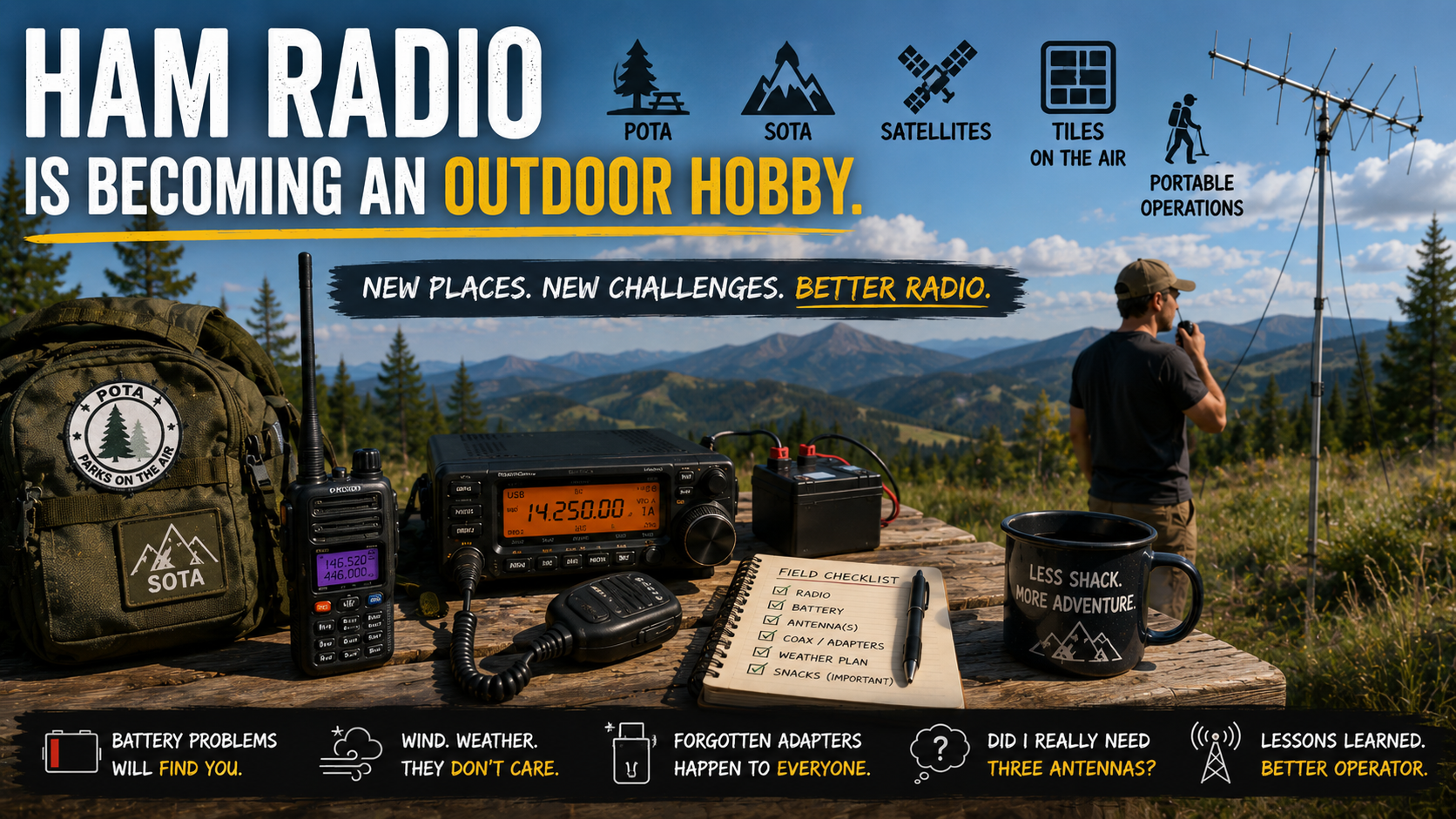
Ham radio is becoming an outdoor hobby.
And I think that’s one of the best things that could happen to it.
The Shack Isn’t Going Anywhere
Before someone starts composing an email explaining the benefits of a 70-foot tower and a legal-limit amplifier…
Relax.
Traditional ham radio isn’t disappearing.
There will always be operators who enjoy building incredible home stations.
There will always be contest stations.
DXers.
Rag chewers.
Operators who have spent years improving their antenna systems one dB at a time.
That’s part of amateur radio.
But for a long time, the shack was the image people had of the hobby.
A desk.
A big radio.
A wall of equipment.
Maybe a world map.
And, depending on the operator, enough coax coming through the wall to concern a building inspector.
Today, the image of amateur radio is changing.
A radio on a picnic table.
An antenna hanging from a tree.
A backpack on the side of a mountain.
Someone standing in a field pointing a Yagi at the sky.
That’s still ham radio.
It’s just happening somewhere different.
POTA Opened the Door
I think Parks on the Air deserves a lot of credit for this.
POTA gave operators a reason to leave the shack.
More importantly, it gave portable operating structure.
You weren’t just taking a radio into the woods.
You were activating a park.
There was a map.
There were spots.
There were awards.
There were hunters waiting to work you.
Suddenly, portable radio had a purpose.
And once operators realized they could put a radio, battery, and antenna into a bag and make contacts from a picnic table…
the rabbit hole opened.
SOTA.
Satellites.
Tiles on the Air.
VHF contests.
Field operating.
Portable digital modes.
Camping with radios.
Now I see operators planning outdoor trips around where they can play radio.
That’s a pretty big shift.
Keep the Conversation Going
What’s one thing you stopped bringing to activations because you realized you never actually needed it? Drop into the Discord and tell the Brew Crew.
Join the N1JUR DiscordRadio Gives Us a Reason to Go Somewhere
This might be my favorite part of portable operating.
The radio becomes the excuse.
I probably wouldn’t drive to some random park, set up a chair, and sit there for two hours by myself.
That would be weird.
Put an FT-891 on the table and suddenly I have a mission.
I’m activating.
I’m testing an antenna.
I’m hunting parks.
I’m trying a new setup.
The radio gives us a reason to explore.
I’ve visited parks because of POTA that I probably never would have known existed.
I’ve operated from places where the view was better than the band conditions.
And I’ve had activations where I made fewer contacts than I wanted but still had a great day.
That’s something we sometimes forget.
The log isn’t always the experience.
Sometimes the location is.
Outdoor Radio Teaches You Different Lessons
Operating outside also exposes every weakness in your station.
In the shack, everything is controlled.
Your radio has power.
Your antenna is connected.
Your chair is comfortable.
If you forgot something, it’s probably ten feet away.
Outside?
You discover very quickly that the one adapter you need is sitting on your workbench.
At home.
You learn how long your battery actually lasts.
You learn how difficult it is to read a radio screen in direct sunlight.
You learn that wind apparently has a personal problem with antenna masts.
And you learn that a setup that looked perfect on the floor of your garage can be incredibly annoying to deploy in the real world.
That’s valuable.
Portable radio forces you to understand your station.
You don’t just use the equipment.
You learn how all the pieces work together.
Tip #1: Build the Station Around the Trip
One of the biggest mistakes I made with portable radio was trying to build one station that did everything.
HF.
VHF.
UHF.
Digital.
Satellite.
APRS.
Emergency communications.
Probably espresso if I could find the correct Powerpole adapter.
The result was a lot of gear.
Now I try to ask a simpler question.
What am I actually doing today?
If I’m going to a park for a lunchtime activation, I don’t need the same station I would bring for an all-day event.
If I’m working satellites, I probably don’t need 100 feet of coax and an 80-meter antenna.
If I’m hiking, every pound matters.
Build the station around the trip.
Not every radio trip needs every radio.
Want More Portable Radio Content?
Practical portable operating, POTA discussions, gear reviews, Brew & Activate livestreams, and real-world ham radio content.
Tip #2: Weather Is Part of Your Station
Hams love talking about propagation.
We should probably spend a little more time talking about the weather directly above our heads.
Heat.
Cold.
Wind.
Rain.
All of these affect how long you’re going to enjoy operating.
I’ve packed the perfect radio station and completely underestimated the conditions outside.
Guess what happens?
The activation gets shorter.
A small tarp, rain jacket, sunscreen, gloves, or an extra layer can make more difference to your activation than another antenna.
And protect your equipment.
A radio might survive a few drops of rain.
That doesn’t mean we need to test the manufacturer’s confidence.
I keep simple bags and covers available so I can protect equipment quickly.
Outdoor operating means planning for the environment.
The radio isn’t the only thing that needs to work.
You do too.
Tip #3: Stop Packing for Every Possible Failure
This one is difficult.
Especially for me.
Portable operators tend to pack gear based on fear.
What if this cable fails?
What if the antenna doesn’t work?
What if I need another connector?
What if someone asks me to work 80 meters during my 30-minute lunchtime activation?
Before long, you’re carrying three antennas, two radios, four coax cables, and enough adapters to open a small RadioShack.
Bring reasonable backups.
But accept that sometimes things won’t work.
That’s part of portable radio.
If an antenna fails, troubleshoot it.
If the battery dies, figure out why.
If you forgot the microphone…
Well…
That’s going to be a short activation.
The goal isn’t to eliminate every possible problem.
The goal is to learn how your station behaves when something goes wrong.
Tip #4: Make Setup and Breakdown Part of the Test
Everyone talks about how a station performs on the air.
I think deployment matters just as much.
How long does it take to get on the air?
How many bags do you have to carry?
How many times do you walk back to the truck?
Can you pack everything quickly if the weather changes?
After an activation, I usually have opinions about my gear.
This cable is too long.
That bag is annoying.
This antenna takes too much time.
I never used that piece of equipment.
Those notes matter.
Your portable station should evolve.
The station I use today shouldn’t look exactly like the station I used two years ago.
Every activation is a field test.
Pay attention to what the field is telling you.
Tip #5: Bring Someone With You
Portable radio doesn’t have to be a solo activity.
Some of my favorite activations have involved other operators.
You see different stations.
Different antennas.
Different ways of solving the same problem.
One operator shows up with 70 pounds of gear.
Another operator pulls a radio and a wire out of a backpack and is on the air in five minutes.
Both stations make contacts.
That’s the fun part.
Bring a new ham.
Invite someone from your club.
Host a meetup.
Let someone get on the microphone.
Outdoor radio creates a much easier environment for people to experience the hobby.
A person might feel uncomfortable walking into someone’s shack and touching a $5,000 radio.
At a picnic table?
“Here. Push this button and say your callsign.”
That’s how people get hooked.
Maybe This Is What Ham Radio Needed
We spend a lot of time worrying about the future of amateur radio.
Are young people interested?
Are repeaters quiet?
Are clubs shrinking?
Is FT8 taking over?
Is 146.52 dead?
Maybe we’ve been looking at the hobby through the wrong window.
Because when I go to parks, hamfests, portable meetups, and outdoor events, I see people experimenting.
They’re building antennas.
They’re comparing batteries.
They’re trying satellites.
They’re activating parks.
They’re figuring out how to fit an entire HF station into a backpack.
That doesn’t look like a dying hobby.
It looks like a hobby changing where it happens.
Like What’s Happening Here?
N1JUR is built around helping more people get active in ham radio through videos, Field Notes, POTA content, live streams, gear reviews, and community.
If you already watch the channel and want to support more of the work behind it, memberships are one way to help keep the signal going.
Videos. Field Notes. Live Streams. Community.
Membership support helps keep the N1JUR ecosystem moving without turning every page into a pledge drive wearing a callsign hat.
Learn About the Community →The Outdoors Is a Pretty Big Shack
Ham radio doesn’t need to leave the shack.
But it also doesn’t need to stay there.
POTA reminded us we could operate from parks.
SOTA put radios on mountains.
Satellite operators started pointing antennas at the sky.
Other programs are giving us even more excuses to open a map and go somewhere.
And I’m completely fine with that.
Because every time someone packs a radio into a bag and walks outside, they have to interact with the hobby differently.
They experiment.
They adapt.
They learn.
And usually they come home thinking about the next activation.
So maybe ham radio is becoming an outdoor hobby.
Good.
The outdoors is a pretty big shack.
Grab a radio.
Pack an antenna.
And go play radio.