
KIDS ON THE AIR
Want to bring ham radio to kids in your community but aren't sure where to start? You don't need a huge budget, a classroom full of equipment, or a complicated curriculum.
You need a few volunteers, some hands-on activities, a community partner, and a plan that gets kids touching, building, listening, finding signals, and eventually getting on the air.
Let kids experience it.
Build something. Find a hidden transmitter. Hear a repeater. Make a contact. Ask questions. Discover that radio is far bigger than a microphone sitting on a desk.
THE HOBBY DOESN'T NEED ANOTHER LECTURE.
Young people already live in a world built around wireless technology. Amateur radio gives us an opportunity to show them what is happening behind that technology — while adding experimentation, electronics, communication, problem-solving and community.
Make It Hands-On
Kids remember finding a transmitter, building an antenna and hearing their first signal far longer than they remember a PowerPoint slide.
Make Radio Approachable
You don't need to begin with license questions and band plans. Start with curiosity. Give them a reason to want to learn the rest.
Give Them a Next Step
A youth event shouldn't end when everybody goes home. Connect interested students with study resources, mentors, your club and a path toward earning their own callsign.
START A KIDS-ON-THE-AIR PROGRAM IN FIVE STEPS
Don't start by trying to create a week-long ham radio camp. Start small, prove the concept, learn from it, and build from there.
Find a Community Partner
Start with a school, library, Scout group, 4-H program, makerspace, summer camp, STEM program or youth organization. They already have the students, facilities and relationships. Your club brings the radio experience.
Build a Small Volunteer Team
You do not need twenty volunteers. Find a handful of club members who enjoy teaching, building and working with beginners. Assign specific activities so nobody is trying to run everything.
Choose Experiences, Not Lectures
Give students something to do: operate a handheld, build a simple antenna, hunt a transmitter, listen to repeaters, make supervised contacts or participate in a portable station.
Plan Responsible Radio Use
Decide in advance what equipment will be used, what frequencies will be programmed, when licensed control operators are required, and what students and parents need to understand about transmitting.
Give Interested Kids Somewhere to Go Next
Finish with a clear path toward licensing: study resources, local exam opportunities, club mentors and another event where they can use what they learned.
BUILD THE DAY AROUND DOING RADIO
These activities can become a single youth event, a weekend program, or individual modules spread across several meetings.
Get a Radio in Their Hands
Teach the controls, channels, listening, radio etiquette and the difference between receiving a signal and being authorized to transmit.
Build an Antenna
A simple tape-measure Yagi turns antennas from an abstract concept into something students can build, hold and immediately use.
Go Find RF
Use those antennas for a fox hunt. Direction finding introduces antennas, signals and problem-solving while feeling more like a game than a class.
Get Them On the Air
Finish by putting radio into context. Demonstrate repeaters, simplex, HF, POTA or another supervised operating activity and let students experience an actual contact.
YOU PROBABLY ALREADY HAVE MOST OF WHAT YOU NEED.
Start with the resources already inside your club. Build the program around the people and equipment you actually have rather than waiting for the perfect setup.
School, camp, library, Scouts, 4-H, STEM organization or similar.
People who want to teach and encourage rather than simply demonstrate.
Plan supervision around any amateur-radio transmitting activities.
Handheld radios are enough to teach a surprising amount.
An antenna build, fox hunt or other activity gives kids ownership.
Let students hear and experience amateur radio actually working.
Explain radio use, supervision, licensing and what happens after the event.
Provide study material, mentors and information about local testing.
Want to Get More Kids and Families Interested in Ham Radio?
One of the biggest challenges amateur radio clubs face is figuring out how to introduce the hobby to younger operators, families, schools, and the broader community in a way that feels hands-on, exciting, and approachable.
I speak with amateur radio clubs about practical community outreach, youth engagement, Ham Radio Camps, STEM activities, Parks on the Air, fox hunting, antenna projects, and other ways clubs can move beyond simply talking about amateur radio and start creating experiences people remember.
If your club wants to build stronger community outreach, attract new operators, or create its own youth ham radio program, I'd be happy to share what we've learned and help generate ideas your club can actually put into action.
Topics Can Include
- Building youth-focused ham radio programs
- Creating hands-on community outreach events
- Using POTA and portable operating to engage newcomers
- Fox hunting and radio direction finding activities
- Simple antenna and STEM projects for kids
- Turning curiosity into new licensed operators
- Helping clubs become more visible in their communities
DON'T START FROM A BLANK PAGE.
These are resources developed from an actual youth ham radio program. Download them, adapt them for your club, and use them as a starting point for your own community outreach.
INFORMATION LETTER
Parent / Guardian Radio Information Letter
A detailed communication template covering student radios, responsible operation, licensing requirements, channel use, supervision and how families can continue toward an Amateur Radio license.
Download the Parent Letter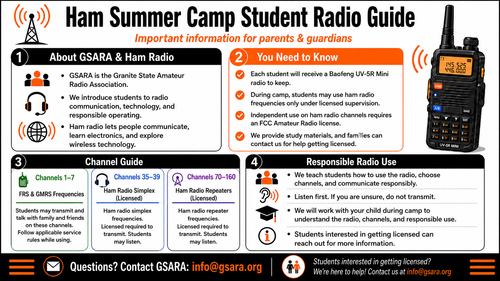
Ham Summer Camp Student Radio Guide
A visual reference for students and parents covering radios, channel groups, licensing, supervision and responsible radio use.
Download the Radio Guide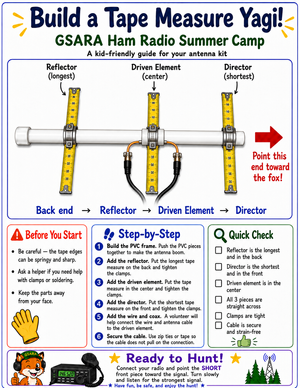
Tape Measure Yagi Build Guide
A kid-friendly visual guide for assembling a simple directional antenna that can become the foundation of a fox-hunting activity.
Download the Yagi Guide
IF YOU'RE NOT SURE — LISTEN FIRST.
Putting a frequency into a radio doesn't automatically mean you are authorized to transmit on it. We teach students to understand what they're listening to, what radio service they're using, and when a license or licensed supervision is required.
If you're unsure whether you can transmit, listen first and don't press the transmit button until you know.
WHAT DOES A KIDS-ON-THE-AIR PROGRAM ACTUALLY LOOK LIKE?
We documented our experience putting young people behind radios, building antennas, learning about RF, hunting signals and experiencing amateur radio firsthand.