What You’ll Find Here
This blog is where I go deeper than a YouTube description. You’ll find practical ham radio guides, activation lessons, gear breakdowns, and field notes from real operating experiences.
Some posts are beginner-friendly. Some get a little more technical. And some are just honest lessons from the field — because not every activation goes perfectly, and that’s usually where the good stuff happens.
Portable operating tips
POTA, SOTA, and location-based activation ideas
Gear and antenna experiments
Beginner-friendly ham radio guides
Field stories and lessons learned
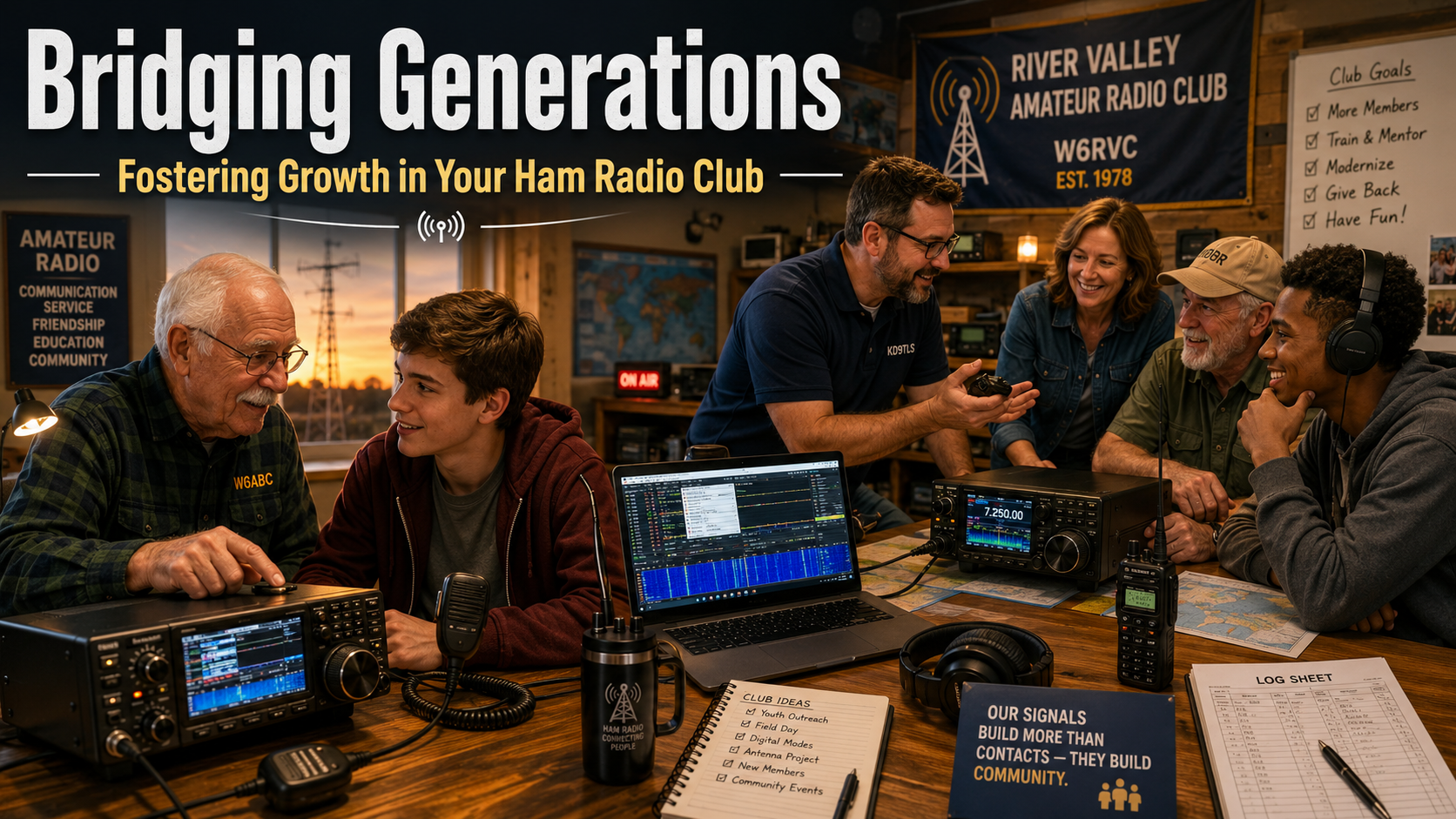
Bridging Generations and Fostering Growth in Your Struggling Ham Radio Club
Whether it’s dwindling membership, a lack of engagement, or just a general sense of stagnation, it can be tough to keep the momentum going. But fear not! As a leader, you have the power to turn things around and foster growth while bridging the gap between generations. Let’s explore some fun and effective ways to rejuvenate your club and create an inclusive environment that appeals to everyone.
Hey there, fellow radio enthusiasts! If you’re reading this, chances are you’re part of a ham radio club that might be facing some challenges. Whether it’s dwindling membership, a lack of engagement, or just a general sense of stagnation, it can be tough to keep the momentum going. But fear not! As a leader, you have the power to turn things around and foster growth while bridging the gap between generations. Let’s explore some fun and effective ways to rejuvenate your club and create an inclusive environment that appeals to everyone.
1. Embrace the Spirit of Collaboration
One of the first steps to rejuvenating your club is fostering a collaborative atmosphere. Encourage members to share their ideas and experiences, regardless of their age or level of expertise. Set up brainstorming sessions where everyone can contribute. You might be surprised at how many innovative ideas can come from a mix of seasoned hams and newcomers. Creating this open dialogue helps everyone feel valued and invested in the club’s future.
2. Plan Multi-Generational Activities
Organizing activities that appeal to both younger and older members can be a game changer. Consider hosting tech workshops where experienced members can pass on their knowledge about traditional radio techniques while younger members can introduce new technologies, like digital modes or software-defined radios. This exchange of skills not only fosters growth but also builds camaraderie among members of different generations.
Want More Portable Radio Content?
Practical portable operating, POTA discussions, gear reviews, Brew & Activate livestreams, and real-world ham radio content.
3. Host Social Events
Sometimes, all it takes to breathe new life into a club is a little socializing! Organize relaxed gatherings where members can share stories, enjoy snacks, and get to know each other outside of formal meetings. Whether it’s a BBQ, a picnic, or a game night, these casual events can strengthen relationships and spark interest in club activities. Plus, they’re a great way to attract potential new members who might be curious about what ham radio is all about.
4. Incorporate Technology
Let’s face it: technology is a big part of our lives today, and it’s especially relevant in the world of amateur radio. Integrating technology into your club activities can help engage younger members and give seasoned hams a chance to learn something new. Consider setting up online meetings, virtual contests, or even a club blog where members can share tips and experiences. This approach not only helps bridge the generational gap but also keeps the club relevant in our tech-driven world.
5. Create a Mentorship Program
A mentorship program can be incredibly beneficial in fostering growth and building connections between generations. Pairing seasoned operators with newcomers allows for knowledge transfer while also creating lasting friendships. Mentors can guide their mentees through the licensing process, assist with technical challenges, or simply share stories from their own ham radio journeys. This kind of support can make a huge difference in retaining new members and keeping the enthusiasm alive.
6. Encourage Community Involvement
Getting involved in community events is a great way to raise your club’s profile and attract new members. Set up a booth at local fairs, host emergency communication drills, or offer to help with community service projects. These activities not only showcase the value of amateur radio but also provide opportunities for members of all ages to work together toward a common goal.
7. Keep the Communication Flowing
Regular communication is essential for keeping members engaged and informed. Consider sending out newsletters or using social media to keep everyone updated on upcoming events, activities, and achievements. Highlighting member successes or sharing interesting articles related to amateur radio can foster a sense of community and pride in your club.
Final Thoughts
Leading a struggling ham radio club can feel daunting, but with a little creativity and a commitment to fostering growth, you can bridge the generational gap and create a vibrant, inclusive community. By embracing collaboration, planning engaging activities, incorporating technology, and encouraging mentorship, you’ll not only revive your club but also ensure that the spirit of amateur radio continues to thrive for years to come. So, let’s get out there, connect with one another, and make our clubs a place where everyone feels welcome and inspired! Happy hamming!
Like What’s Happening Here?
N1JUR is built around helping more people get active in ham radio through videos, Field Notes, POTA content, live streams, gear reviews, and community.
If you already watch the channel and want to support more of the work behind it, memberships are one way to help keep the signal going.
Videos. Field Notes. Live Streams. Community.
Membership support helps keep the N1JUR ecosystem moving without turning every page into a pledge drive wearing a callsign hat.
Learn About the Community →Ham Alert: The Tool Every POTA Hunter Should Probably Be Using
Ham Alert is one of those tools that sounds simple until you realize how powerful it actually is. If you hunt POTA, chase DX, follow friends, or just want to stop refreshing spotting pages like a raccoon with a caffeine problem, this guide and playlist will help you get started.
Stop Refreshing the Spot Page LIKE it owes you money
Let’s be honest.
A lot of us have done it.
You’re sitting there with a coffee, the radio on, the log open, the POTA page up, maybe QRZ open in another tab, and you’re refreshing everything like the next great contact is going to appear if you just stare hard enough.
That works.
Sort of.
But it is also a fantastic way to turn ham radio into a part-time air traffic control job.
That is where Ham Alert comes in.
Ham Alert is a free tool that sends notifications when specific amateur radio spots show up. That could be a callsign, a park reference, a DXCC, a band, a mode, a SOTA summit, a POTA reference, or a bunch of other conditions you care about. Instead of constantly checking spotting pages manually, Ham Alert watches for you and lets you know when something matches your trigger.
In other words, it is like having a tiny radio nerd assistant in your pocket yelling:
“Hey. That thing you wanted? It’s on the air.”
Which is both useful and slightly dangerous if you already have too many radios.
What Is Ham Alert?
Ham Alert is a notification system for amateur radio spots. It can pull from sources like the DX Cluster, Reverse Beacon Network, SOTAwatch, POTA, WWFF Spotline, and PSK Reporter. You create triggers based on the things you care about, and when a matching spot appears, Ham Alert can notify you.
That might sound a little dry, so here is the plain-English version:
Ham Alert helps you know when the good stuff is happening.
For example, you can use it to get notified when:
A friend or favorite activator gets spotted
A specific POTA park goes on the air
A needed DXCC shows up
Someone is active on a certain band or mode
A CW, FT8, SSB, or digital contact opportunity appears
A rare summit, island, or park reference is spotted
And that is where this gets really useful for POTA hunters.
Because hunting is not just about power.
It is timing.
And timing beats power more often than people want to admit.
Why Ham Alert Matters for POTA Hunters
POTA hunting can be a blast, but it can also turn into absolute chaos.
One second you are casually drinking coffee.
The next second someone spots a rare park and suddenly the pileup sounds like someone kicked over a shopping cart full of callsigns.
Ham Alert helps you get ahead of that.
Instead of waiting until everyone else sees the same spot, you can build alerts around the activators, parks, bands, and modes that actually matter to you.
That means less random searching and more intentional hunting.
You are not just spinning the dial and hoping.
You are setting up your own little RF early-warning system.
And no, it will not magically make propagation behave.
Nothing does that.
Propagation is still going to be propagation, which is basically the radio version of a moody cat.
But Ham Alert can help you know when an opportunity exists so you can jump in while the window is open.
My Ham Alert Playlist
I put together a full YouTube playlist walking through Ham Alert because this is one of those tools that can look confusing at first, especially when you start getting into triggers, filters, destinations, notifications, and integrations.
The playlist is called “The Complete Guide to Ham Alert” and currently includes multiple videos focused on getting operators set up and using the tool more effectively.
Learn Ham Alert Without Getting Lost in the RF Weeds
I put together this Ham Alert playlist to help you set up smarter notifications for POTA, favorite activators, bands, modes, and the stations you actually care about.
What You Will Learn in the Playlist
This playlist is built to help you go from “I have heard of Ham Alert” to “Okay, now this thing is actually useful.”
You will learn how to:
Set Up Ham Alert From Scratch
If you are brand new, start here.
One of the videos walks through the beginner setup process so you can get your account going, understand the basic layout, and start building useful alerts without immediately wandering into the weeds.
Because yes, there are weeds.
Radio software loves weeds.
Build Better Triggers
Triggers are where Ham Alert becomes powerful.
You can create alerts based on callsign, band, mode, source, POTA reference, DXCC, CQ zone, continent, time of day, spotter information, and more.
This is the difference between getting hammered with random notifications and getting alerts that actually matter.
A bad trigger says:
“Tell me everything.”
A good trigger says:
“Tell me when this specific thing I care about is happening.”
That is the move.
Follow Friends and Favorite Activators
One of the best uses for Ham Alert is getting notified when a specific operator gets spotted.
If you have friends who activate parks, run SOTA, chase DX, or pop up on the air randomly, you can use Ham Alert to know when they are active.
This is especially helpful if you want to support friends, chase specific activators, or stop missing the good stuff because you were doing something responsible like mowing the lawn.
Terrible timing, by the way.
The radio always gets good the second you are outside doing chores.
Use Ham Alert for POTA
For POTA hunters, Ham Alert can be a serious advantage.
You can use it to watch for activators, parks, references, and conditions that matter to your own hunting goals.
Trying to work a specific park?
Following a certain activator?
Looking for a specific band or mode?
Ham Alert can help you narrow the noise down to something useful.
That is the key.
The goal is not more alerts.
The goal is better alerts.
Customize Notifications
Ham Alert supports different ways to receive alerts, including app notifications, Telnet, Threema, and URL GET/POST options. The official help page also notes that the Ham Alert app can receive free push notifications and show spots from the past 24 hours.
For most operators, the phone app is probably the easiest place to start.
For the advanced crowd — and yes, I see you sitting there thinking about Discord integrations, dashboards, automations, and probably a Raspberry Pi you forgot was still running — the URL notification options open up some fun possibilities.
This is where Ham Alert can become part of your larger shack or community workflow.
Useful?
Yes.
Potentially overbuilt?
Also yes.
But that has never stopped hams before.
A Quick Warning: Do Not Alert Yourself Into Madness
Here is the part people need to hear.
Just because you can create a million alerts does not mean you should.
If you make your triggers too broad, your phone is going to start buzzing like it just joined a contest weekend against its will.
Start simple.
Pick one or two useful alerts.
Maybe a favorite activator.
Maybe a specific park.
Maybe a mode or band you are chasing.
Then build from there.
Ham Alert is powerful, but it is only helpful if the alerts are actually meaningful.
Otherwise, you are just creating a tiny notification monster and feeding it RF snacks.
Ham Alert Is Not a Propagation Forecast
This is worth saying clearly.
Ham Alert tells you when spots appear. It is not the same thing as a propagation forecast.
A Ham Alert forum support reply explains that Ham Alert should be treated as a tool for alerts based on cluster or Reverse Beacon Network spots, not as a propagation prediction system.
That distinction matters.
If you get an alert, it means something was spotted.
It does not guarantee you will hear it.
It does not guarantee you can work it.
It does not guarantee the band will stay open long enough for you to finish your coffee and casually stroll over to the radio.
It means there is an opportunity.
And in ham radio, opportunity is usually half the battle.
The other half is antenna choice, timing, patience, and occasionally muttering at the ionosphere.
Who Should Use Ham Alert?
Ham Alert is useful for a lot of different operators.
POTA Hunters
This is the obvious one.
If you hunt parks, Ham Alert can help you know when activators or references you care about show up.
POTA Activators
Activators can also use it to keep track of friends, other parks, or conditions around their operating window.
DX Chasers
If you are chasing needed countries, bands, or modes, Ham Alert can help narrow down when something you care about is spotted.
CW Operators
Reverse Beacon Network spots can be especially useful for CW activity.
Digital Operators
PSK Reporter-based activity can be useful too, although Ham Alert’s help page notes that PSK Reporter spots may involve filtering behavior to reduce bad alerts.
Clubs and Communities
This is where things get fun.
A club or Discord community can use Ham Alert-style workflows to help members know when special events, activations, or friends are on the air.
That is not just useful.
That builds activity.
And activity builds community.
My Recommended Ham Alert Starting Setup
If you are brand new, do not try to build the ultimate alert system in one sitting.
That way lies madness, tabs, and probably a forgotten password reset.
Start with this:
1. Create One Callsign Alert
Pick a friend, favorite activator, or operator you want to follow.
Set a trigger for their callsign.
Make sure it sends an app notification.
Test it.
2. Create One POTA-Focused Alert
Pick a park, reference, or POTA-related condition that matters to you.
Do not go wild.
Keep it narrow.
You can always add more later.
3. Add Band or Mode Filters
If you only care about certain bands or modes, filter for them.
This keeps the alert useful instead of turning your phone into a slot machine.
4. Watch What Happens
Let it run.
See what alerts you get.
Then adjust.
Ham Alert is not really a “set it once and forget it forever” tool.
It is more like antenna tuning.
You get close, test it, tweak it, then pretend you meant to do that all along.
Why I Made This Playlist
I made this playlist because Ham Alert is one of those tools that can genuinely help operators get more out of the hobby, but only if they understand how to set it up in a way that matches how they actually operate.
A POTA hunter does not need the same setup as a DX chaser.
A CW operator does not need the same setup as someone following phone activations.
A club member trying to support local operators may want something totally different.
That is why a playlist makes sense.
You can go step by step.
Watch the beginner setup.
Learn how triggers work.
Dig into notifications.
Then start building the system that works for your radio life.
Not someone else’s.
Yours.
Final Thought
Ham radio is already full of noise.
Some of it is RF.
Some of it is bad coax.
Some of it is just us making things more complicated than they need to be.
Ham Alert helps cut through some of that noise.
Used well, it can make you a better hunter, a more connected operator, and a little quicker on the draw when the right spot shows up.
And if nothing else, it gives your phone one more reason to interrupt your day with radio nonsense.
Which, honestly, is kind of the point.
Like What’s Happening Here?
N1JUR is built around helping more people get active in ham radio through videos, Field Notes, POTA content, live streams, gear reviews, and community.
If you already watch the channel and want to support more of the work behind it, memberships are one way to help keep the signal going.
Videos. Field Notes. Live Streams. Community.
Membership support helps keep the N1JUR ecosystem moving without turning every page into a pledge drive wearing a callsign hat.
Learn About the Community →The Beard Challenge Has Begun… Blame Shannon
The Beard Challenge has officially begun… and yes, Shannon KC1OHT is absolutely to blame. During the latest Brew & Activate livestream, a simple joke turned into a full-blown community challenge: if we raise $500 in Super Chats, I’ll grow a beard. It’s ridiculous, it’s community-driven, and somehow it is now officially a thing. Check out the stream that started it all, join us for the next Brew & Activate, and help push the chaos toward the goal.
Well, folks… it happened.
Somewhere during the latest episode of Brew & Activate, while we were hanging out, talking ham radio, drinking coffee, and trying to keep the show somewhere near the rails, Shannon — KC1OHT — decided to toss an idea into the universe.
And like most ideas that start on a livestream, it immediately got out of hand.
The challenge?
If the community raises $500 in Super Chats, I will grow a beard.
Yes. A beard.
Not a “forgot to shave for a weekend” beard. Not a “I was busy editing videos and lost track of time” beard.
A real, honest-to-goodness, community-funded, RF-powered beard.
How Did This Start?
Like many questionable decisions in ham radio, it started with someone saying, “You know what would be funny?”
During the latest Brew & Activate livestream, Shannon had the idea that the community should come together and raise money through Super Chats — with the reward being that I would have to grow out a beard.
At first, I laughed.
Then the chat reacted.
Then people started encouraging it.
Then somehow, before I could key the mic and call “QRT,” the Beard Challenge became a thing.
This is what happens when you give hams caffeine, YouTube chat, and a target number.
The Goal: $500 in Super Chats
The challenge is simple:
If we reach $500 in Super Chats, I grow the beard.
That’s it. That’s the deal.
The community gets to help push the channel forward, support the work we are building here, and apparently also influence my grooming choices.
I’m not saying this is a good idea.
I’m saying it is now an official idea.
And that’s somehow worse.
Why Are We Doing This?
Besides the obvious reason — because Shannon started trouble and the chat ran with it — this is really about continuing to build something fun around the N1JUR / Brew Crew community.
Super Chats help support the channel, the livestreams, the gear reviews, the behind-the-scenes work, the website, the content, and all the ham radio madness we keep putting together.
This isn’t just about growing a beard.
It’s about growing the community.
Although, unfortunately for my face, both may happen at the same time.
Keep the Conversation Going
What’s one thing you stopped bringing to activations because you realized you never actually needed it? Drop into the Discord and tell the Brew Crew.
Join the N1JUR DiscordHow You Can Join the Chaos
Want to be part of the Beard Challenge?
Join us during the next Brew & Activate livestream and help push the Super Chat total toward the $500 goal.
You can also jump into the chat, cheer it on, heckle me respectfully, and remind Shannon that she is responsible for this entire situation.
Watch the stream that started it all here Latest Brew & Activate.
Final Thoughts Before My Face Loses the Fight
I never expected ham radio to lead to this.
I expected antennas, activations, pileups, coax debates, battery math, maybe the occasional “why won’t my radio transmit?” conversation.
But a beard challenge?
That one was not on the bingo card.
Still, this community continues to show up, have fun, support the channel, and turn simple ideas into full-blown events.
So here we go.
The Beard Challenge is officially underway.
If we hit $500 in Super Chats, I grow the beard.
Blame Shannon.
Support the channel.
And may the RF be weird.
Like What’s Happening Here?
N1JUR is built around helping more people get active in ham radio through videos, Field Notes, POTA content, live streams, gear reviews, and community.
If you already watch the channel and want to support more of the work behind it, memberships are one way to help keep the signal going.
Videos. Field Notes. Live Streams. Community.
Membership support helps keep the N1JUR ecosystem moving without turning every page into a pledge drive wearing a callsign hat.
Learn About the Community →Why Most Portable Setups Fail Before You Even Key Up
The operator who gets on the air quickly almost always ends up having more fun than the operator building a NASA ground station in the parking lot.
Overpacking Kills Motivation
This is the part people don’t talk about enough.
Heavy setups slowly make you not want to activate.
Portable operating is supposed to make the radio feel simpler.
Get outside.
Throw an antenna in the air.
Make some contacts.
Have a good time.
But somewhere along the way, a lot of us accidentally turned portable radio into a traveling electronics convention.
Extra radios.
Extra batteries.
Backup coax for the backup coax.
Adapters for situations that probably aren’t going to happen.
Cases full of gear that never even gets touched.
And before you even key up, you’re already mentally exhausted.
The Problem Usually Isn’t the Radio
Most portable setups don’t fail because the radio is bad.
They fail because the setup became too complicated.
You spend more time:
unpacking
organizing cables
troubleshooting
second-guessing
moving gear around
than actually operating.
I’ve done this myself more times than I’d like to admit.
You get to the park and suddenly the activation feels like work instead of fun.
That’s usually the warning sign.
Complexity Creates More Failure Points
Every extra thing you bring creates another opportunity for something to go sideways.
More cables.
More adapters.
More connectors.
More batteries.
More software.
More distractions.
And the funny part?
Most of the time we bring this stuff “just in case” and never use it anyway.
Portable operating rewards simplicity far more than most people realize.
The setups that consistently work are usually the boring ones:
One radio
One antenna
One battery
Simple logging
Fast deployment
That’s it.
The operator who gets on the air quickly almost always ends up having more fun than the operator building a NASA ground station in the parking lot.
Overpacking Kills Motivation
This is the part people don’t talk about enough.
Heavy setups slowly make you not want to activate.
If every activation means:
hauling multiple bags
sorting tangled cables
setting up complicated systems
tearing everything down for 45 minutes afterward
you’ll start talking yourself out of going.
You’ll wait for “the right day.”
You’ll convince yourself you need more time.
You’ll tell yourself the setup effort isn’t worth it.
Meanwhile, the operator with the small radio and a simple antenna is already making contacts.
Simple Setups Make You More Consistent
One of the biggest breakthroughs in portable radio is realizing you don’t need to bring your entire shack into the field.
You just need enough gear to make contacts reliably.
That shift changes everything.
Simple setups:
deploy faster
create fewer problems
reduce stress
encourage more activations
make experimentation easier
And maybe most importantly:
they make radio feel fun again.
The Best Portable Operators Usually Simplify Over Time
Something interesting happens after enough activations.
Most experienced portable operators slowly start bringing less gear.
Not more.
They stop chasing perfection and start optimizing for:
efficiency
reliability
repeatability
enjoyment
Because after enough field time, you realize something important:
Nobody remembers how many adapters you packed.
They remember the contacts.
The experience.
The park.
The conversations.
The fun.
What Actually Works?
The best portable setups I’ve used — and the ones I keep coming back to — usually have a few things in common:
Fast setup and teardown
Minimal points of failure
Gear I already understand well
Lightweight enough that I don’t dread carrying it
Flexible enough to adapt without becoming complicated
That’s the sweet spot.
Not the fanciest setup.
Not the most expensive setup.
Not the setup with the most gear.
The setup that gets you on the air consistently.
Final Thoughts
A portable radio should lower the barrier to getting on the air, not raise it.
If your setup feels overwhelming, frustrating, or exhausting before you even make your first contact, that’s probably your sign to simplify.
Strip it down.
Take less gear.
Trust your skills a little more.
And remember:
The goal isn’t to build the most complicated field station possible.
The goal is to get outside, make contacts, and enjoy radio.
Like What’s Happening Here?
N1JUR is built around helping more people get active in ham radio through videos, Field Notes, POTA content, live streams, gear reviews, and community.
If you already watch the channel and want to support more of the work behind it, memberships are one way to help keep the signal going.
Videos. Field Notes. Live Streams. Community.
Membership support helps keep the N1JUR ecosystem moving without turning every page into a pledge drive wearing a callsign hat.
Learn About the Community →Pre-Activation Generic Checklist [US-TEST]
Introducing the POTA US-TEST Checklist – your go-to guide for planning your very first activation! Get ready to embark on an exciting adventure and ensure you’re fully prepared every step of the way!
Check out these links
1) Planning and documentation
Activation plan: target park, date/time window, bands and modes, expected contact goals.
Local rules and permissions: park regulations, permits, access restrictions, noise limits, temporary closures.
Emergency and contact info: emergency plan, nearest hospital, trip/partner contact, GPS coordinates of the activation site.
Test log: a section to record test results and any deviations from the plan.
2) Power and power management
Primary radio power source: confirm voltage, available capacity, and regulator status.
Backup power: spare battery or alternative power source ready and charged.
Load check: verify system can sustain planned transmission power for the activation duration.
Charging plan: solar or AC charging available and tested (if applicable).
Power distribution: test power cables, Anderson/XT connectors, fuses, and polarity protection.
3) RF hardware and antenna system
Transceiver/ALL RF path: turn-on self-check, nominal current draw, and audio/RF path integrity.
Antenna(s): verify mounting, feedpoint connections, and physical security.
Feedline and connectors: inspect for wear, water ingress, corrosion; test continuity with a ohm-meter if available.
SWR/match device: verify antenna tuner or ATU operation; record baseline SWR on planned bands.
Grounding/bonding: verify proper grounding and RF safety practices.
Coax protection: strain reliefs, weatherproofing, and grommet integrity.
4) Microphones, keying, and operator interfaces
Key/Keyer or paddle: check response, touch sensitivity, and debouncing.
Microphone/voice keys: test audio levels and sidetone.
Logging and contest software: confirm software launches, device connections, and correct callsign/park reference.
Digital modes equipment: ensure USB sound card/interface is recognized, drivers installed, and sample rates set correctly.
5) Station layout and physical security
Setup layout: outline where each piece of gear will go for quick star-up and safe operation.
Stowage and transport: secure all items to prevent movement and damage during transport.
Weather readiness: check shelter (if used), rain covers, and sun protection for gear.
6) Safety and RF exposure
RF exposure assessment: quick check of safe distances for all operators, especially if high-gain antennas or high power is used.
Ground fault protection: GFCI where applicable and proper insulation of exposed conductors.
First aid and PPE: gloves for handling antennas, eye protection if using rotating parts, and any required PPE.
Fire safety: fire extinguisher accessible; check batteries and power equipment for overheating risks.
7) RF test and verification (bench-to-field)
Power-on self-test: verify device self-test passes.
Battery/load test: measure voltage under load; ensure within acceptable range.
RF path test: perform a quick SWR check on the planned bands; confirm tuning works with the tuner.
RX/ TX sanity: verify receive audio levels and transmit function on a known good frequency.
Mock contact: complete a 1–2 sample QSO to validate timing, logging, and spotting workflows.
8) Bands, modes, and software readiness
Band plan alignment: Confirm that the modes and bands you intend to operate on are clear and permitted.
Mode readiness: CW, SSB, FT8/FT4, etc.; verify software configurations and timers.
Logging integrity: ensure callsign database and park reference are correct; verify backup logging method.
9) Redundancy and contingency planning
Spare parts: keep spare fuses, connectors, patch cables, and a spare battery or two.
Alternate plan: identify an alternate park or backup site in case of access issues.
Troubleshooting guide: brief, written steps for common failures (no transmit, SWR mismatch, software crash).
10) Post-activation wrap-up
Power-down procedure: safe power-down sequence to protect gear.
Data backup: save logs, QSOs, and any notes from the activation.
Debrief: quick team review to capture what worked and what to improve.
Template fields you can fill in later (example format)
Park: [Park name and ID]
Date/Time window: [YYYY-MM-DD, local time]
Bands and Modes: [e.g., 20m CW/SSB, 40m FT8]
Power: [e.g., 60 W, 100 W]
Antenna: [type and model]
Transceiver: [brand/model]
Power source: [battery type, solar, AC]
Safety officer: [name]
Checklist completed by: [name] at [time)
Like What’s Happening Here?
N1JUR is built around helping more people get active in ham radio through videos, Field Notes, POTA content, live streams, gear reviews, and community.
If you already watch the channel and want to support more of the work behind it, memberships are one way to help keep the signal going.
Videos. Field Notes. Live Streams. Community.
Membership support helps keep the N1JUR ecosystem moving without turning every page into a pledge drive wearing a callsign hat.
Learn About the Community →