
Why Most Portable Setups Fail Before You Even Key Up
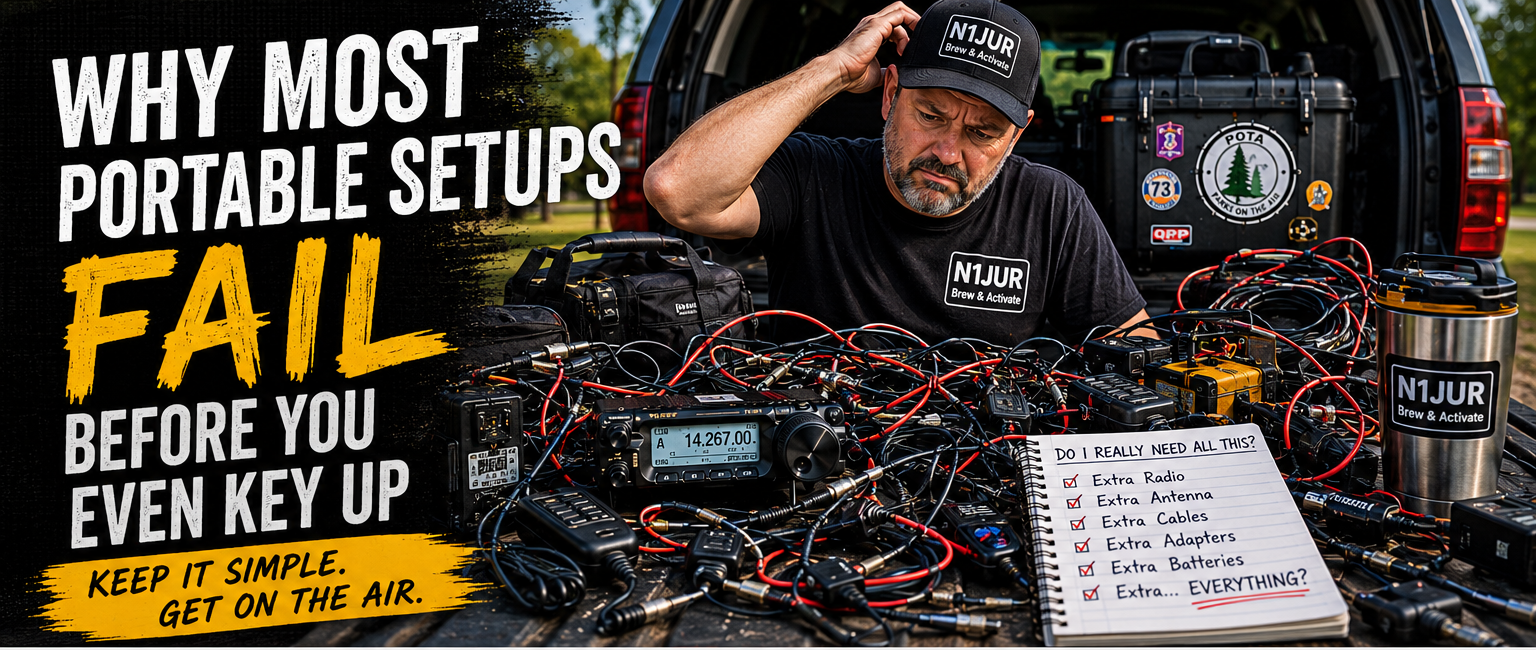
Portable operating is supposed to make the radio feel simpler.
Get outside.
Throw an antenna in the air.
Make some contacts.
Have a good time.
But somewhere along the way, a lot of us accidentally turned portable radio into a traveling electronics convention.
Extra radios.
Extra batteries.
Backup coax for the backup coax.
Adapters for situations that probably aren’t going to happen.
Cases full of gear that never even gets touched.
And before you even key up, you’re already mentally exhausted.
The Problem Usually Isn’t the Radio
Most portable setups don’t fail because the radio is bad.
They fail because the setup became too complicated.
You spend more time:
unpacking
organizing cables
troubleshooting
second-guessing
moving gear around
than actually operating.
I’ve done this myself more times than I’d like to admit.
You get to the park and suddenly the activation feels like work instead of fun.
That’s usually the warning sign.
Complexity Creates More Failure Points
Every extra thing you bring creates another opportunity for something to go sideways.
More cables.
More adapters.
More connectors.
More batteries.
More software.
More distractions.
And the funny part?
Most of the time we bring this stuff “just in case” and never use it anyway.
Portable operating rewards simplicity far more than most people realize.
The setups that consistently work are usually the boring ones:
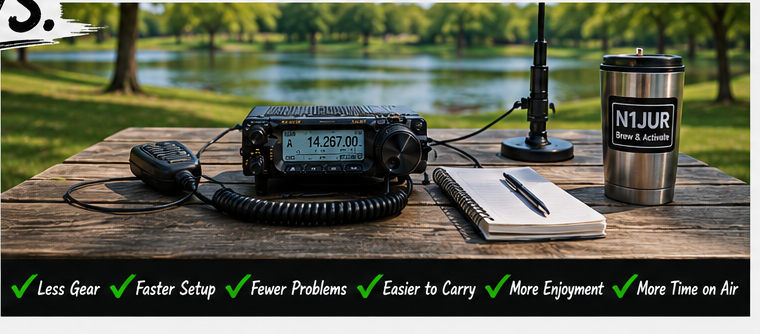
One radio
One antenna
One battery
Simple logging
Fast deployment
That’s it.
The operator who gets on the air quickly almost always ends up having more fun than the operator building a NASA ground station in the parking lot.
Overpacking Kills Motivation
This is the part people don’t talk about enough.
Heavy setups slowly make you not want to activate.
If every activation means:
hauling multiple bags
sorting tangled cables
setting up complicated systems
tearing everything down for 45 minutes afterward
you’ll start talking yourself out of going.
You’ll wait for “the right day.”
You’ll convince yourself you need more time.
You’ll tell yourself the setup effort isn’t worth it.
Meanwhile, the operator with the small radio and a simple antenna is already making contacts.
Simple Setups Make You More Consistent
One of the biggest breakthroughs in portable radio is realizing you don’t need to bring your entire shack into the field.
You just need enough gear to make contacts reliably.
That shift changes everything.
Simple setups:
deploy faster
create fewer problems
reduce stress
encourage more activations
make experimentation easier
And maybe most importantly:
they make radio feel fun again.
The Best Portable Operators Usually Simplify Over Time
Something interesting happens after enough activations.
Most experienced portable operators slowly start bringing less gear.
Not more.
They stop chasing perfection and start optimizing for:
efficiency
reliability
repeatability
enjoyment
Because after enough field time, you realize something important:
Nobody remembers how many adapters you packed.
They remember the contacts.
The experience.
The park.
The conversations.
The fun.
What Actually Works?
The best portable setups I’ve used — and the ones I keep coming back to — usually have a few things in common:
Fast setup and teardown
Minimal points of failure
Gear I already understand well
Lightweight enough that I don’t dread carrying it
Flexible enough to adapt without becoming complicated
That’s the sweet spot.
Not the fanciest setup.
Not the most expensive setup.
Not the setup with the most gear.
The setup that gets you on the air consistently.
Final Thoughts
A portable radio should lower the barrier to getting on the air, not raise it.
If your setup feels overwhelming, frustrating, or exhausting before you even make your first contact, that’s probably your sign to simplify.
Strip it down.
Take less gear.
Trust your skills a little more.
And remember:
The goal isn’t to build the most complicated field station possible.
The goal is to get outside, make contacts, and enjoy radio.
Like What’s Happening Here?
N1JUR is built around helping more people get active in ham radio through videos, Field Notes, POTA content, live streams, gear reviews, and community.
If you already watch the channel and want to support more of the work behind it, memberships are one way to help keep the signal going.
Videos. Field Notes. Live Streams. Community.
Membership support helps keep the N1JUR ecosystem moving without turning every page into a pledge drive wearing a callsign hat.
Learn About the Community →