
Meshtastic vs. Ham Radio: Are We Ignoring What New Operators Actually Want?
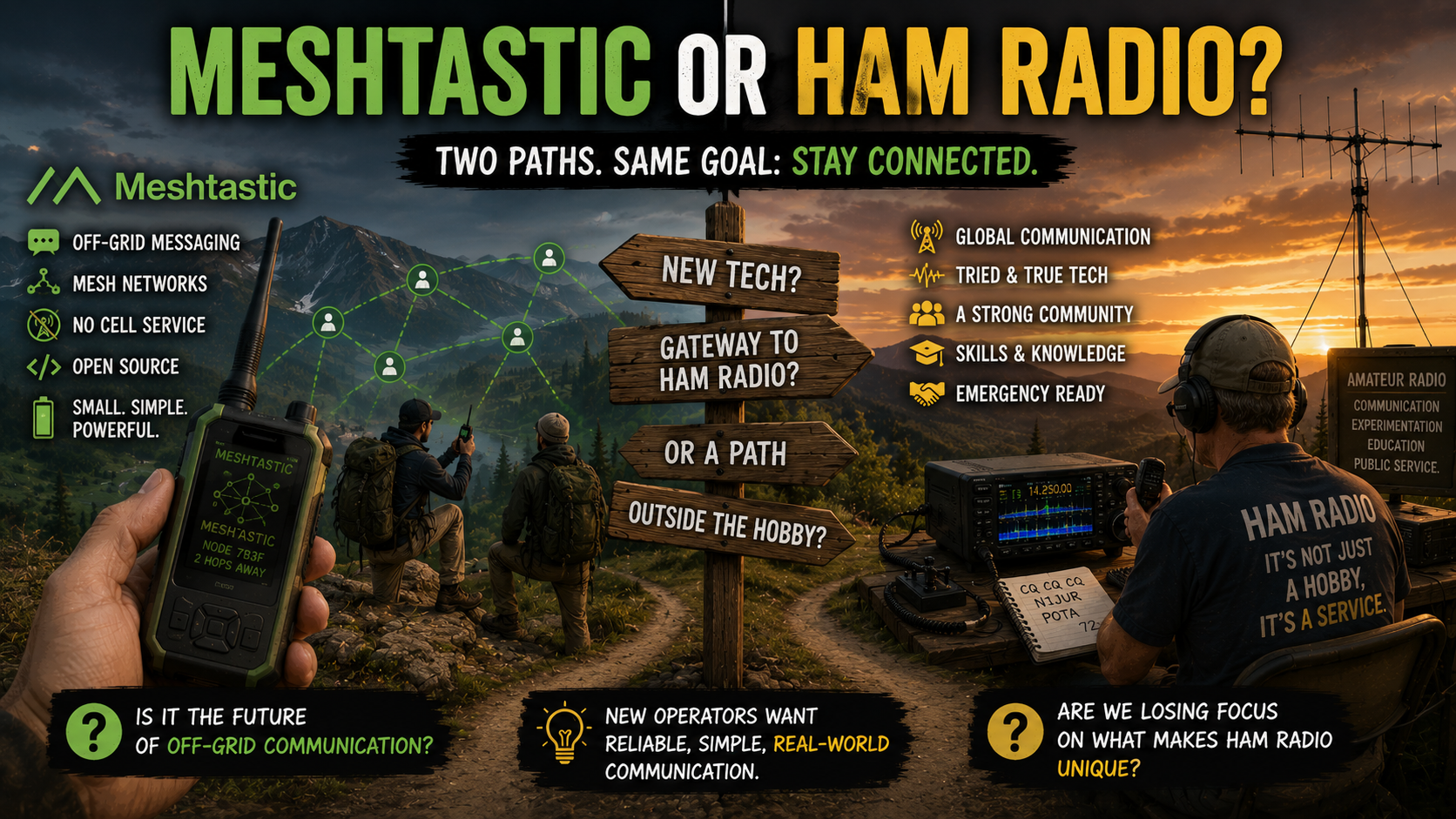
I’ve been watching the Meshtastic and MeshCore conversations for a while now.
And I’ll admit it.
It’s cool.
Small devices. Low power. Off-grid messaging. GPS. Mesh networks. No cell service required.
Put a little radio in a box, attach an antenna, and suddenly you’re sending messages across town through a network of nodes.
For anyone who likes radio and technology, it’s really easy to fall down this rabbit hole.
But I’ve started to wonder something.
Are we looking at Meshtastic and MeshCore because they’re a gateway into amateur radio?
Or are hams slowly branching further and further outside amateur radio in the name of “off-grid communications?”
Because I’m starting to think those are two very different conversations.
First… Meshtastic Isn’t Ham Radio
We should probably get this out of the way.
Meshtastic isn’t a ham radio mode.
MeshCore isn’t a ham radio mode.
They’re communications technologies that use low-power LoRa radios to create mesh networks.
And that’s perfectly fine.
Not everything with an antenna has to be amateur radio.
I use radios, cameras, networking equipment, streaming gear, and all kinds of technology that doesn’t fall under Part 97.
The problem starts when we try to force every interesting communications technology into the amateur radio box.
I’ve heard hams talk about Meshtastic like it’s the next FT8.
Or APRS 2.0.
Or the future of emergency communications.
Maybe.
But I think we need to be careful about what we’re actually talking about.
Because sometimes a communications tool is just a communications tool.
Why Are Hams So Interested in This Stuff?
This is the more interesting question.
Why are amateur radio operators so attracted to Meshtastic and MeshCore?
I think the answer is pretty simple.
They solve a problem.
Turn the device on.
Connect your phone.
Send a message.
That’s it.
You don’t need to understand repeaters.
You don’t need to program a codeplug.
You don’t need to figure out offsets, tones, talkgroups, gateways, or which digital voice standard everyone in your area decided to use.
The technology largely disappears.
You just communicate.
Compare that to handing a new ham a radio.
“Okay, first we’re going to download this programming software.”
“Now we need the correct driver for the cable.”
“No, not that cable.”
Want More Portable Radio Content?
Practical portable operating, POTA discussions, gear reviews, Brew & Activate livestreams, and real-world ham radio content.
“Okay, now we’re going to import the repeater list.”
“Make sure the tone is correct.”
“That’s the input frequency.”
“No, you transmit there but listen over here.”
And then we wonder why someone buys a Baofeng, listens for three days, and puts it in a drawer.
Meshtastic might not be amateur radio.
But it may be telling us something very important about what people actually want.
New Operators Want to Do Something
I think sometimes we misunderstand why people get interested in radio.
They don’t necessarily want to learn radio theory on day one.
They want to do something.
Send a message.
Talk to someone.
Track a location.
Build a network.
Communicate from a campsite.
See how far a signal travels.
Meshtastic gives you an immediate result.
Amateur radio sometimes gives you a 400-page study guide.
Now, before someone sends me an email explaining why understanding electronics is important…
I agree.
Learning is a huge part of amateur radio.
Experimentation is literally built into the hobby.
But maybe we’ve confused the destination with the starting point.
You don’t teach someone to fish by starting with the molecular structure of water.
You hand them a fishing rod.
Let them catch a fish.
Then they start asking questions.
Why did that lure work?
Why are the fish over there?
What happens if I change this?
Curiosity comes after the experience.
Is Meshtastic a Gateway to Ham Radio?
This is where I think amateur radio has a massive opportunity.
Imagine someone buys a Meshtastic device.
They put a node at their house.
Then they build another node.
Then they start experimenting with antennas.
Suddenly they’re asking questions.
Why does this antenna work better?
Why can’t I reach the node behind the hill?
What happens if I increase antenna height?
Why does terrain matter?
Congratulations.
You’re basically having a radio conversation.
Now introduce amateur radio.
“You know… there’s an entire hobby built around experimenting with this stuff.”
HF.
Satellites.
APRS.
Digital modes.
Weak signal.
Repeaters.
Microwave.
Mesh networking.
Suddenly the amateur radio license isn’t the first obstacle.
It’s the next level.
That’s a completely different way of introducing someone to the hobby.
Keep the Conversation Going
What’s one thing you stopped bringing to activations because you realized you never actually needed it? Drop into the Discord and tell the Brew Crew.
Join the N1JUR DiscordOr Are We Just Chasing Off-Grid Communications?
Here’s the part I’m still wrestling with.
There is a growing group of operators who seem more interested in “off-grid communications” than amateur radio.
Meshtastic.
GMRS.
Satellite messengers.
MeshCore.
Starlink.
Wi-Fi mesh networks.
Every new device gets added to the communications bag.
And again… there is nothing wrong with that.
I actually think understanding multiple communication systems is incredibly valuable.
But at some point, we have to ask:
Are we experimenting with radio?
Or are we just collecting ways to send a text message without a cell tower?
Those aren’t necessarily the same thing.
Amateur radio was never supposed to be the perfect communications system.
If the only goal is reliable communication, there are usually better tools.
A satellite messenger will probably beat your QRP HF station when you need to send one critical message.
Starlink will move more data than your Winlink station.
Your phone will outperform almost every radio you own when the network is working.
Ham radio is different.
The value is understanding how the communication happens.
Building the station.
Experimenting with the antenna.
Changing the mode.
Seeing what works.
And sometimes figuring out why absolutely nothing works.
That’s the hobby.
We Don’t Need to Turn Meshtastic Into Ham Radio
I don’t think we need to adopt Meshtastic as a ham radio mode.
I don’t think we need to force MeshCore into Part 97.
And I don’t think we need to slap a callsign on every LoRa device just to justify playing with it.
We can enjoy communications technology outside amateur radio.
More importantly, we can use it to start conversations.
Someone interested in Meshtastic already understands the basic appeal of radio.
Wireless communication.
Range.
Antennas.
Networks.
Experimentation.
That’s a pretty good starting point.
Maybe instead of telling them:
“That’s not real ham radio.”
We ask:
“Want to see what else you can do with a radio?”
Maybe We’re Ignoring What New Operators Are Telling Us
Meshtastic and MeshCore are popular for a reason.
They’re accessible.
They’re visual.
They’re interactive.
You can see the network.
You can send a message.
You can immediately experiment.
Maybe the lesson isn’t that amateur radio needs to become Meshtastic.
Maybe the lesson is that amateur radio needs to get better at showing people the fun part first.
Get someone on the air.
Let them make a contact.
Let them track a satellite.
Let them send an APRS message.
Let them build an antenna.
Let them activate a park.
Then explain why it worked.
We spend a lot of time telling people what they need to learn before they can enjoy amateur radio.
Maybe we should spend more time showing them why they would want to learn it.
Like What’s Happening Here?
N1JUR is built around helping more people get active in ham radio through videos, Field Notes, POTA content, live streams, gear reviews, and community.
If you already watch the channel and want to support more of the work behind it, memberships are one way to help keep the signal going.
Videos. Field Notes. Live Streams. Community.
Membership support helps keep the N1JUR ecosystem moving without turning every page into a pledge drive wearing a callsign hat.
Learn About the Community →So… Meshtastic vs. Ham Radio?
I don’t think it’s a competition.
Meshtastic is a tool.
MeshCore is a tool.
Amateur radio is a hobby built around experimentation, communication, and learning.
The danger isn’t that Meshtastic replaces ham radio.
The danger is that people discover these new communications technologies, start experimenting with antennas, propagation, and networks…
and nobody from amateur radio invites them to see what comes next.
So maybe the question isn’t whether Meshtastic belongs in ham radio.
Maybe the question is whether we’re paying attention to why people are excited about it.
Because they might already be radio people.
They just don’t have a callsign yet.
And maybe all we need to do is invite them to come play radio.